The Flying Saucer At Sunset

Lenticular clouds (Altocumulus lenticularis) are stationary lens-shaped clouds with a smooth layered appearance that form in the troposphere, usually above mountain ranges. One was spotted in Singapore recently...

Eyes Of 30,000 Honeycombs

With 30,000 individual facets, dragonflies have the most number of facets among insects. Each facet, or ommatidia, creates its own image, and the dragonfly brain has eight pairs of descending visual neurons to compile those thousands of images into one picture...

A Kaleidoscope Of Colours, Shapes And Patterns

Spectacular and innovative in design, the Flower Dome replicates the cool-dry climate of Mediterranean regions like South Africa, California and parts of Spain and Italy. Home to a collection of plants from deserts all over the world, it showcases the adaptations of plants to arid environments...

Lightning Strikes, Not Once, But Many Times

Unlike light, lightning does not travel in a straight line. Instead, it has many branches. These other branches flashed at the same time as the main strike. The branches are actually the step leaders that were connected to the leader that made it to its target...

Are You My Dinner Tonight?

A T-Rex has 24-26 teeth on its upper jaw and 24 more on its lower jaw. Juveniles have small, sharp blade-shaped teeth to cut flesh, whereas adults have huge, blunt, rounded teeth for crushing bones. Is the T-Rex a bone-crushing scavenger?

Tulipmania - Bringing A Mini Holland To Singapore

Gardens By The Bay
Marina Bay
South, Singapore
April 2014

Singapore’s largest popular tulip display - Tulipmania - is back at the Flower Dome at Gardens by the Bay from 14 April to 4 May 2014.


“Gardens by the Bay is proud to announce the second installation of Tulipmania  following last year’s success. We are delighted to have KLM Royal Dutch Airlines on board again to bring a slice of their heritage to our Gardens - with Miffy in tow this year." 
- Dr. Kiat W. Tan, Chief Executive Officer, Gardens by the Bay -


Tulipmania is part of the Europe leg of the “Gardens by the Bay Goes around the World” series of floral displays for 2014, bringing a “mini Holland” to Singapore. 
 
 
"Tulipmania is part of the exciting line-up of programmes designed to encourage people from all walks of life to enjoy the wonders of the plant kingdom in the Gardens.”
- Dr. Kiat W. Tan -


Blooms abound in the Flower Dome...

A typical Dutch landscape with townhouses, tulip fields, windmills and a Dutch cheese market greets visitors to Tulipmania. The miniature blue delft houses here are on loan from KLM roayal Dutch Airlines. These have been given as mementos to passengers on board KLM inter-continental Business Class flights since 1952...
 
The tulip display at the Flower Field resembles the beautiful city of Amsterdam, famed for its canals, tulip gardens and characteristic architecture that is truly Dutch...

Little touches that liven up the distinctly Dutch atmosphere...

Lots of people partake in the buoyant atmosphere of the Dutch landscape...

Tulipmania itself is an attraction to visitors to Singapore too...
 
Staff soaking in the atmosphere and doing a little fun jig amidst the blooms...

Inspired by Madurodam, a miniature park and tourist attraction in the Netherlands, the centrepiece will depict Dutch canal scenes, houses and windmills set amidst spectacular blooms of tulips and hyacinths. The star of the display will be the tulips flown in from the Netherlands, in a myriad of varieties and colours including red, yellow, orange, purple and white - all 50,000 of them - cool climate blooms airflown direct into the heart of our tropical climate. 


 Thank you, Gardens By The Bay...


More photos are available on Merlion Wayfarer Goes Green's Picasa at :
Gardens By The Bay


Lorong Halus - Among The Mangroves

Lorong Halus
East, Singapore
April 2014

As the sun sets, Merlion Wayfarer wandered among the mangroves at dusk...

In the dark, this Oxyopes birmanicus (Burmese Lynx Spider) seems well-hidden. 
The only telltale signs are the browns of its body against the stark white of the flowers...

A unique V-patterned moth (Heterocera) waits on a branch...

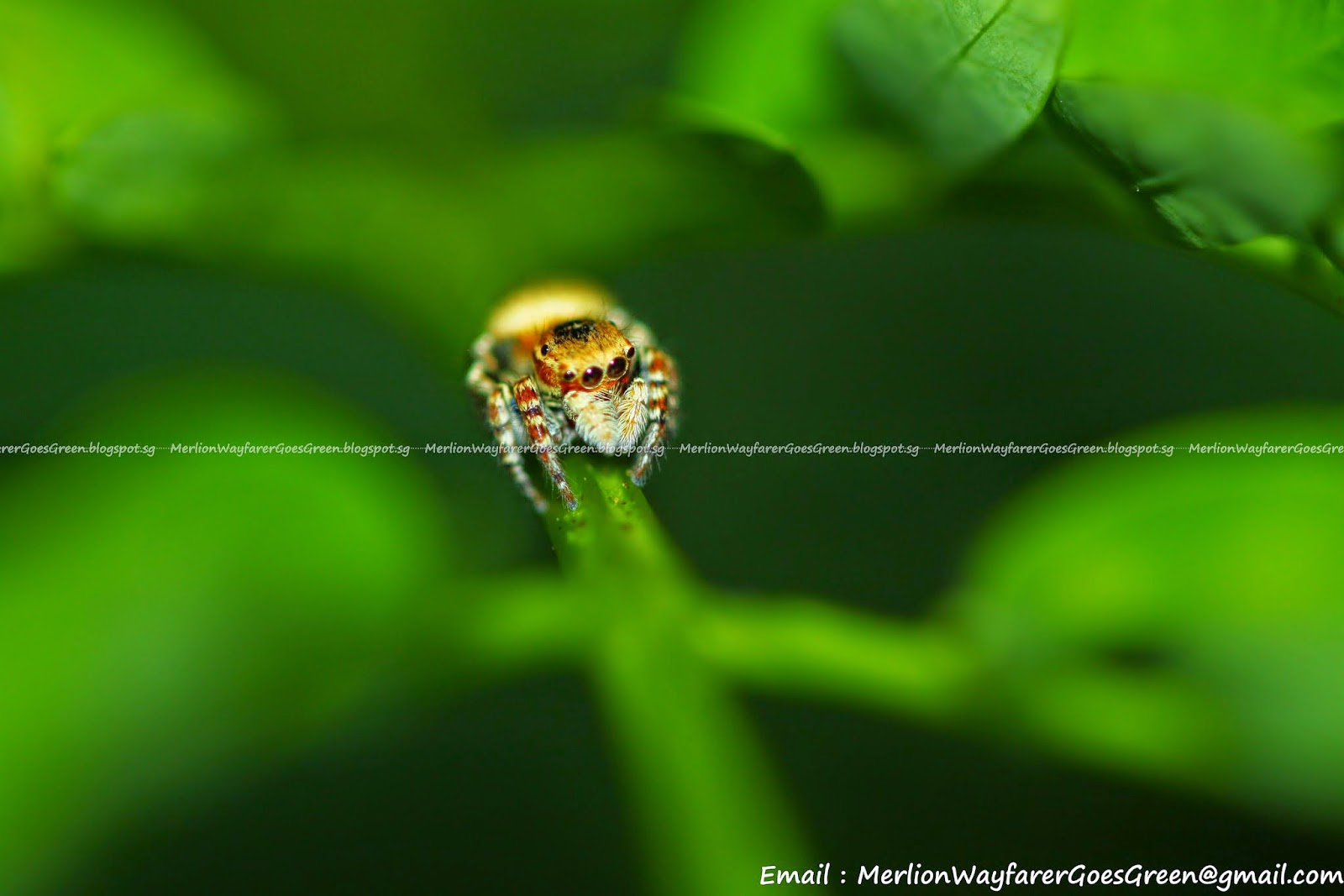
A bronze female Ligurra latidens (Mangrove Jumper) wanders about, hopping from stalk to stalk...


More photos are available on:


The Day After The Full Moon

Singapore
15 February 2014
 
14 February 2014 was the night of the full moon. It was also the night of the Chinese Valentine's Day, falling on the 15th day of the Lunar New Year.
 
The day after the full moon was one full of clouds. For an usually cloudy and windy February, wisps of dark clouds covered a still very bright moon, dulling its pale lemon glow...


More photos are available on Merlion Wayfarer Goes Green's Picasa at :
Natural Phenomena - The Moon


Lower Peirce Reservoir - The Playful Pitta

Lower Peirce Reservoir
North, Singapore
March 2014

Lower Peirce Reservoir welcomed an uncommon visitor last weekend. It was a visitor that drew droves of bird photographers tracking its every move after a posting on a bird sighting forum.

There were two of them - One near the reservoir and the other near a stream. Each photographer was patiently still, moving only to click the shutter for yet another perfect shot.

And being the performer that it was, this Pitta moluccensis (Blue-Winged Pitta) played around with everyone, first hopping about in enjoyment, looking at everything around it, then pecking playfully at a log.


The photos are taken off a scope with a mobile phone camera, 
generously lent by a friendly birdwatcher...
(Thank you, my friend!)


More photos are available on Merlion Wayfarer Goes Green's Picasa at : 
Aves - Passeriformes - Pittidae (Pittas)


Bristleworms

Seashores
Singapore

Bristleworms are segmented worms belonging to Phylum Annelida like the more familiar Clitellata (earthworms and leeches). There are about 10,000 species of polychaete worms, making them the largest class of the segmented worms.

North-East Coast, Singapore, January 2013...
(Read about "Bristles That Sting")


They are abundant on our shores, but are rarely seen as they burrow in the ground or remain in other hiding places. In coral rubble, giant reef worms that grow to 1m long hide inside crevices. Others about 10cm long crawl about in sandy and muddy areas. Some beautiful ones swim about in the water. Others live in tubes. Countless microscopic ones too small to see live among the sand grains.

North-East Coast, Singapore, January 2014...

"Polychaeta" means "many bristles". These worms have bodies that are divided into segments (metameres). Except for the head and last segment, all the segments are generally similar. 

Each segment has a pair of flattened extensions called parapodia. These appendages are usually branched at the ends and covered with bristles, called setae. Parapodia show a vast diversity of form and function, serving purposes such as locomotion (moving like a centipede), burrowing, gas exchange, protection, attachment, controlling water flow within a tube, or can be reduced or lost altogether. 


More photos are available on Merlion Wayfarer Goes Green's Picasa at :

Sources