Marang Trail
South, Singapore
February 2015
South, Singapore
February 2015
Blue-Spotted Tiger Beetle (Cicindela aurulenta)
Tiger beetles are a large group of beetles known for their aggressive predatory habits and running speed. They have large bulging eyes, long, slender legs and large curved mandibles. All are predatory, both as adults and as larvae. Both Cicindela and Tetracha are often brightly colored, while the other genera mentioned are usually uniform black in color.

The fastest can sprint at up to 5 miles per hour, covering 120 of its body lengths in a single second. For comparison, Usain Bolt covers just 5 body lengths per second. To match the beetle, he’d have to run at 480 miles per hour.

Tiger beetles use this incredible speed to run down both prey and mates. But as they sprint, their environment becomes a blur because their eyes simply can’t gather enough light to form an image. They have extremely sharp vision for insects, but when they’re running, the world smears into a featureless smudge. To compensate, the beetle has to stop to spot its prey again, before resuming the chase.

After reading about how active they are at night, and how fast they can run... It does make it a "miracle" that this little one was stationary on this plant for the entire duration that Merlion Wayfarer was there at the Trail - First when she entered the Trail, and 3 hours later when she left the Trail...
Termites (Blattodea)
Instead of swarms of ants, the dampness of night allowed thousands of big-headed termites to roam around. Unlike ants, they don't bite. But not careful, and you will step into a swarm...


Slugs & Snails (Gastropoda)
This is a snail...

These are slugs...


These slugs look remarkably like snails without shells...

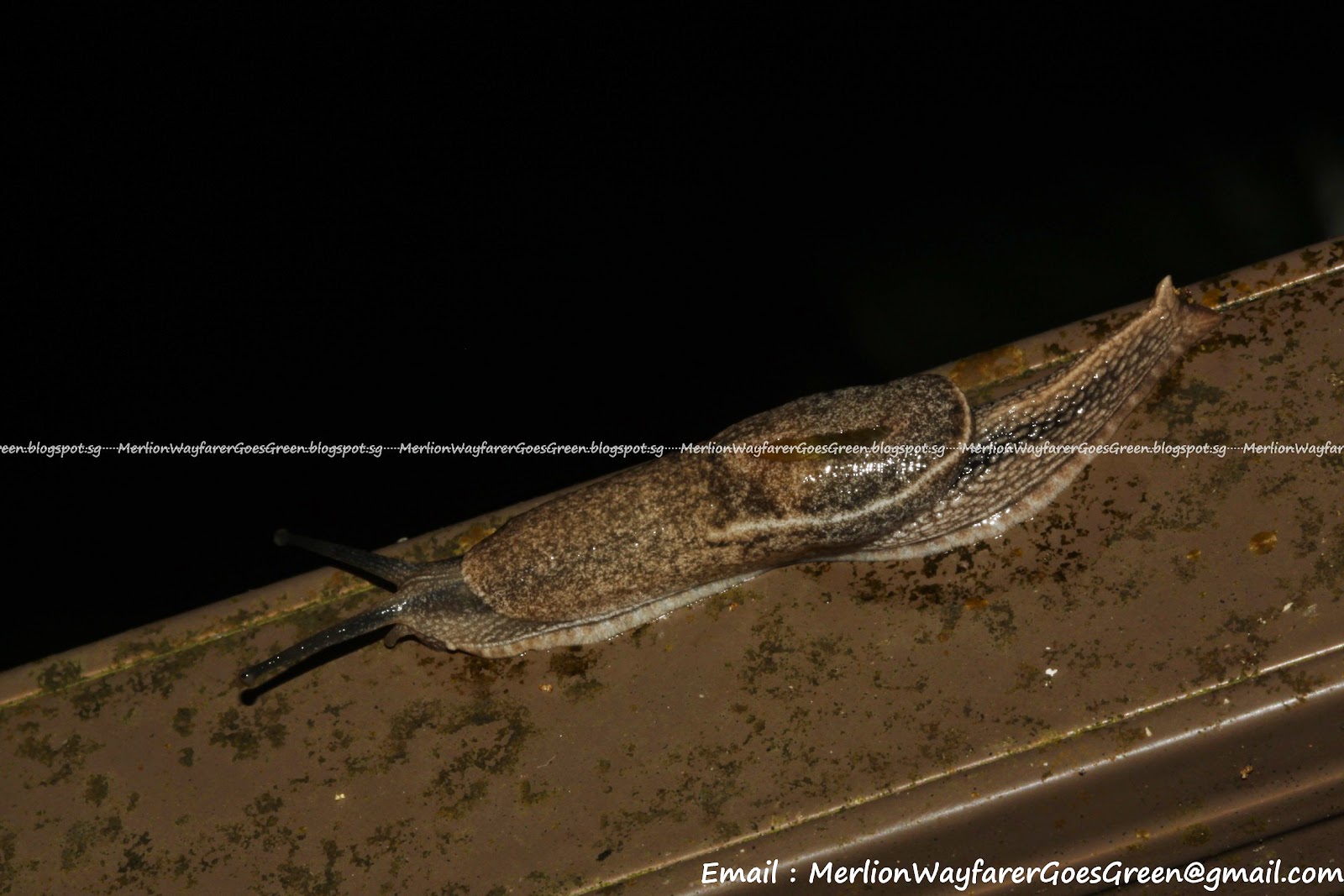
Snails and slugs are both part of the same class of creatures called gastropods. Gastropod comes from the Greek words gastros (stomach) and podos (foot). If you’ve ever seen a snail in an aquarium eating as it moves slowly along the glass, you probably understand why “stomach foot” is an appropriate name.
The most obvious difference between snails and slugs is the fact that snails have shells. A snail’s shell is like a home it carries around on its back. Slugs, on the other hand, have no shell.
Snails and slugs make mucous so that they can move on the ground. The mucus keeps their bodies from losing moisture to the dry soil beneath them. It also protects them from being cut by sharp objects in the soil.
Hirudinea (Leech)
It is always creepy to see these slimy creatures. Looking like a black earthworm,
it slithers along from crevice to crevice...
it slithers along from crevice to crevice...


What makes it a leech?

Leeches differ from the oligochaetes (other worms) in significant ways. For example, leeches do not have bristles and the external segmentation of their bodies does not correspond with the internal segmentation of their organs. Their bodies are much more solid as the spaces in their coelom (main body cavity in a multi-cellular animals) are dense with connective tissues. They also have two suckers, one at each end.

As a point of interest, leeches are hermaphrodites, meaning each has both female and male reproductive organs (ovaries and testes, respectively). Leeches reproduce by reciprocal fertilization, and sperm transfer occurs during copulation. Similar to the earthworms, leeches also use a clitellum (a thickened glandular and non-segmented section of the body wall near the head) to hold their eggs and secrete the cocoon.
Caterpillars (Lepidoptera)
Tussock Moth caterpillars are known for their striking tufts of hair, or tussocks. Many species exhibit four characteristic clumps of bristles on their backs, giving them the appearance of a toothbrush. Some have longer pairs of tufts near the head and rear. Judged by looks alone, these fuzzy caterpillars seem harmless yet many people are allergic to the body hair of tussock moth caterpillars, especially if the hairs are brought into contact with eyes or sensitive areas of skin.Tussock Moth adults are often dull brown or white. Females are usually flightless, and neither males or females feed as adults. They focus on mating and laying eggs, dying within days.


The beautiful cat here with dew on its spikes after the afternoon rainfall...

More caterpillars with those long "harmless-looking" bristles...


This is probably a pupa...

This is probably how an adult looks like...

Cockroaches (Blattodea)
In the dark of the night, these jungle roaches appear. Looking similar yet different to the cockroaches we often see at home...


If one each is not enough, there can always be two...

Whatever Are They?
These yet-to-be-identified Insecta were spotted too...


A hard-to-capture shiny black beetle against a dark background and an easier subject on a green leaf...


The Katydid (Tettigoniidae) with its beautiful lined eyes...

This is a beautiful albino Planthopper (Fulgoroidea) with beady red eyes and coconut husk-like tufts...

The Dragonheads
This is a 3rd instar Elymnias hypermnestra agina (Common Palmfly) Butterfly Caterpillar with its still blackish Masked Rider look. It will mature into a simple brown butterfly adult which is shade-loving, and usually sighted flying along the edge of vegetated area and in the vicinity of a clump of palm trees. The Palmfly adults have the habit of puddling and visiting flowers for mineral and energy intakes....


Sources
- "How Are Slugs and Snails Different?" by Clint Stone from Wonderopolis at http://wonderopolis.org/wonder/how-are-slugs-and-snails-different/ (17-Feb-2015).
- "Meet The Predator That Becomes Blind When It Runs After Prey" (04-Feb-2014) by Ed Yong from National Geographic at http://phenomena.nationalgeographic.com/2014/02/04/tiger-beetles-become-blind-when-they-run/.
- "Leech" at Wikipedia at http://en.wikipedia.org/wiki/Leech (16-Feb-2015).
- "Tiger beetle" at Wikipedia at http://en.wikipedia.org/wiki/Tiger_beetle (12-Feb-2015).
- "Tussock Moth Caterpillars" by Debbie Hadley from About Education at http://insects.about.com/od/photography/ig/Tussock-Moth-Caterpillars/ (16-Feb-2015).