The Flying Saucer At Sunset

Lenticular clouds (Altocumulus lenticularis) are stationary lens-shaped clouds with a smooth layered appearance that form in the troposphere, usually above mountain ranges. One was spotted in Singapore recently...

Eyes Of 30,000 Honeycombs

With 30,000 individual facets, dragonflies have the most number of facets among insects. Each facet, or ommatidia, creates its own image, and the dragonfly brain has eight pairs of descending visual neurons to compile those thousands of images into one picture...

A Kaleidoscope Of Colours, Shapes And Patterns

Spectacular and innovative in design, the Flower Dome replicates the cool-dry climate of Mediterranean regions like South Africa, California and parts of Spain and Italy. Home to a collection of plants from deserts all over the world, it showcases the adaptations of plants to arid environments...

Lightning Strikes, Not Once, But Many Times

Unlike light, lightning does not travel in a straight line. Instead, it has many branches. These other branches flashed at the same time as the main strike. The branches are actually the step leaders that were connected to the leader that made it to its target...

Are You My Dinner Tonight?

A T-Rex has 24-26 teeth on its upper jaw and 24 more on its lower jaw. Juveniles have small, sharp blade-shaped teeth to cut flesh, whereas adults have huge, blunt, rounded teeth for crushing bones. Is the T-Rex a bone-crushing scavenger?

Showing posts with label Birds. Show all posts

Sarawak - More To Discover

Recently Merlion Wayfarer attended a uniquely Sarawakian evening, which saw the Sarawak Minister of Tourism, Arts, Culture, Youth and Sports, the Honourable Datuk Haji Abdul Karim Rahman Hamzah launch the Visit Sarawak logo which preceded its tourism campaign. 

The "Visit Sarawak" Logo

The overall style of the logo is simple, friendly and approachable while keeping its impactful nature. The brush strokes of the logo font portrays a fun and friendliness, representing the unparalleled hospitality found in Sarawak. The different and vibrant colours represent the diversity and multitude of elements that make Sarawak unique.


  • Red and yellow indicate the colours in the Sarawak flag, hence their use in the letters “S” and “R”.
      
  • Orange represents the strong spirit and vibrant energy of the different ethnic communities within Sarawak.
      
  • Green represents the luscious rainforests teeming with life.
      
  • Blue reflects the calmness of the ocean along Sarawak’s long coastline.
      
  • The stylised “S” in the logo features a curling pattern, imitating a traditional design that is often used in the artwork of the Dayak and Orang Ulu people.
      
  • The ‘hornbill head’ in the centre replacing the ‘A’ alphabet represents the “Bumi Kenyalang” that the State has been labelled for many years as well as the cultural significance the hornbill has to the indigenous people of Sarawak. It also adds another natural element to the logo, as one of Sarawak’s main attractions is its nature.

"More To Discover"

The “More to Discover” phrase ensures that a person needs to set foot in Sarawak personally to truly discover all the attractions Sarawak holds. It also promises that once a person has been to Sarawak, there is always more for them to experience and discover, as there is far more within the State than can be experienced by a traveller within one trip.

Discover Culture

As the largest state in Malaysia, Sarawak is home to 27 ethnic groups, speaking 45 languages and dialects, and each with their own stories, colorful cultures, traditions, and beliefs that makes Sarawak a cultural extravaganza just waiting to be explored.

What's a launch event without a bit of excitement?
Here, a tribal performer holds up a wand of balloons while invited members of the audience attempt a tryout with a blowpipe...

Discover Adventures

On land, visitors have a plethora of adventures to choose from – from jungle trekking, adventure caving, to mountain climbing, rock climbing and jungle expeditions. In water, visitors can choose from river activities, diving, water sports, fishing, jet skiing and yachting.

Urban explorers can visit Kuching, which has one of the most interesting architecture mix in Malaysia, with colonial buildings amongst modern architecture.

Discover Nature

Sarawak has a 56 totally protected areas, 37 gazetted national parks, five wildlife sanctuaries and 14 nature reserves, with rainforests the size of Austria. Its rainforests house the world’s richest and most diverse ecosystem - Home to the world’s largest flower, the Rafflesia (that can grow to the size of a coffee table), squirrels and snakes that fly, deer the size of cats, plants that eat insects (and small animals), the orang utan, the proboscis monkey, the hornbill, the Rajah Brooke butterfly and the silverleaf monkey...

The launch of the campaign showed the floral and fauna of Sarawak as a backdrop,
fronted by the graceful movements of a dancer...

For more information on Sarawak Tourism, visit sarawaktourism.com


Bishan Park - The Drain Birds Of Singapore

As Singapore urbanizes, there are fewer and fewer grass patches and water sources for birds to obtain their much needed food. Surprisingly, the drains in Singapore can be a good place for spotting birds. In the revamped Bishan Park, a variety of shorebirds can be seen.


Little Egret (Egretta garzetta) 

The Little Egret (Egretta garzetta) is a species of small heron in the family Ardeidae. It is a white bird with a slender black beak, long black legs and, in the western race, yellow feet. As an aquatic bird, it feeds in shallow water and on land, consuming a variety of small creatures. It breeds colonially, often with other species of water birds, making a platform nest of sticks in a tree, bush or reed bed. Its main difference with its bigger cousins will be in its yellow-stockinged feet.


Sandpipers (Scolopacidae)

Sandpipers have long bodies and legs, and narrow wings. The bills are sensitive, allowing the birds to feel the mud and sand as they probe for food. They generally have dull plumage, with cryptic brown, grey, or streaked patterns.


White-Breasted Waterhen (Amaurornis phoenicurus)

Waterhens are dark slaty birds with a clean white face, breast and belly. They are somewhat bolder than most other rails and are often seen stepping slowly with their tail cocked upright in open marshes or even drains near busy roads. 

Here a mother brings her fledglings out for a walk in the evening...

One gets frightened of the rising water level and refuses to leave a rock, 
flapping its wings in distress until the adult came by to retrieve it...

Little Heron (Butorides striatus)

Little Herons eat mainly small fish and crustacea (especially crabs). They also take amphibians and insects and any other edible titbits, including small mammals.


Often, they perch-and-wait on a branch or root over the water, tucking in their necks and crouching in a low forward position over the water. They may flick their crests up and down as they wait. Little Herons may also jump, plunge or swim after their prey. Or they may use their feet to stir up or rake the surface for titbits. They may even dive into the water. But more impressively, they may bait fish and other prey, e.g., by dropping a leaf onto the surface.


Unfortunately, drains are also an area where
there is a accumulation of rubbish discarded from bigger drains...

Let's clean up our drains so that these birds will thrive...


Rail Corridor - A Peaceful Walk

Bukit Timah
Rail Corridor
Central, Singapore
May 2014

The start of the path seems to go on "forever" in a straight mud-track road. Along the way, several concrete pedestrian bridges crisscross it 


Of Spiders & Creatures Caught In Somethings

A muscular Stoliczka's Crab Spider (Thomisus stoliczka) waving its front legs about 
like Toy Story's Rocky Gibraltar...

A free-roaming Shield Bug (Pentatomoidea)wanders about on a leaf... 

Oblivious to the plight of 2 of its friends who lie entombed in nearby webs...

A short distance away, a grasshopper (Orthoptera ) has a foot bath in a raindrop on a leaf...

The Natural Greenery

The figs are in season now - A laden sprig of Common Yellow Stem Fig (Ficus fistulosa)...

A strong smell wafts through the air - Likewise, the jackfruits are in season too...

Next to the durian, chempedaks and jackfruits have the strongest aroma. The jackfruit is a close cousin of the chempedak with a similar appearance, but is much bigger and rounder, about 4 times the size of a chempadak.

Of Butts & Dragons

A light Malayan Eggfly (Hypolimnas anomala) Butterfly rests on a fern...

Blue Dasher (Brachydiplax chalybea) Dragonfly perches on a stalk of grass...

Of Birds That Fly & Chirp

This is a Pacific Swallow (Hirundo tahitica). The very same bird that zips around the sky and hovers above the surface of the water near water sources...

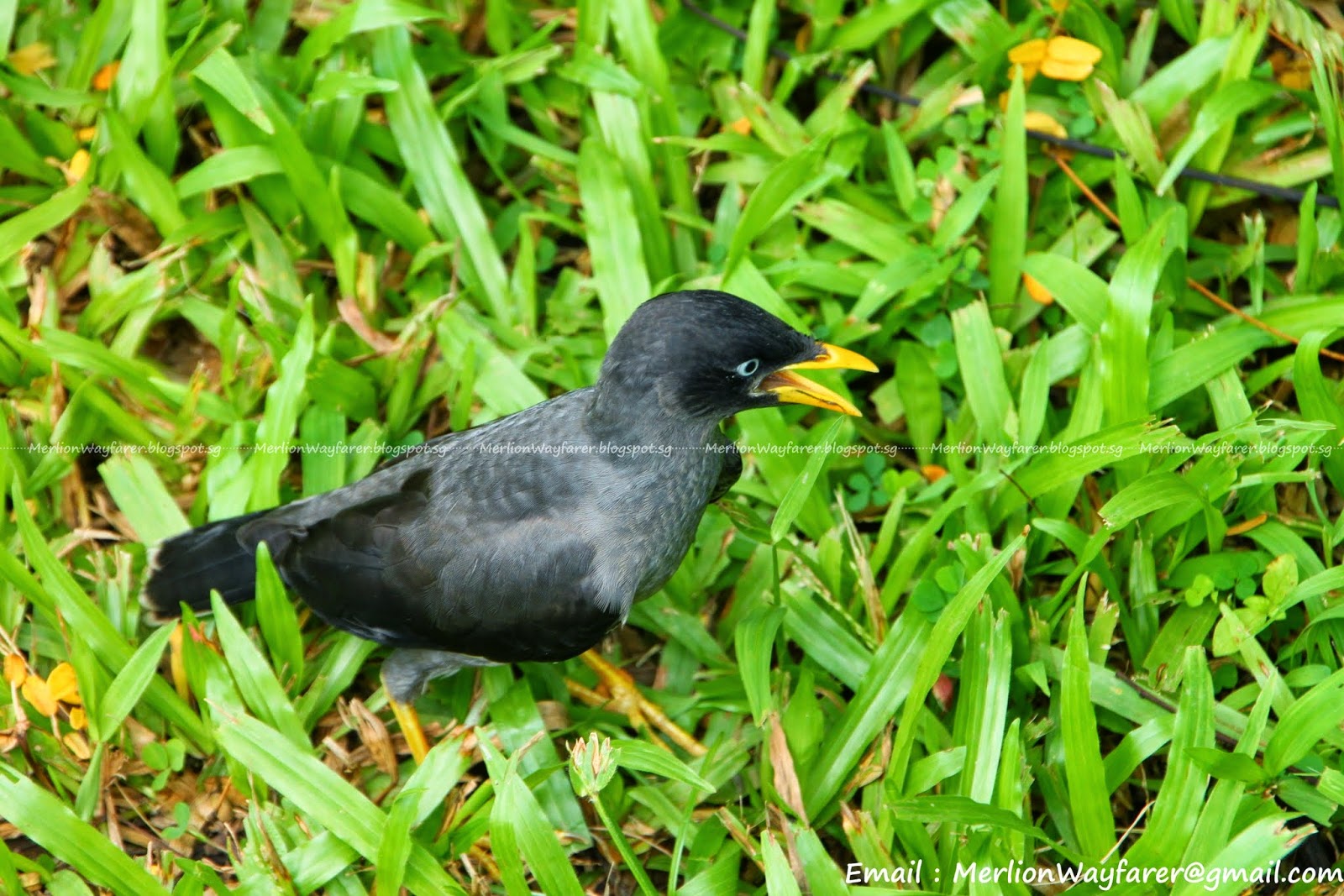
A very tame Javan Myna (Acridotheres javanicus). Instead of the pale yellow blue eyes of its papa and mama, this "baby" version has the clearest pale blue eyes...
(Not noisy too!)

It was certainly a peaceful walk away from the hustle and bustle of city life...


Central Catchment Reserve - Full Of Surprises

Central Catchment Reserve
Central, Singapore
October 2014

The Central Catch Reserve is always full of surprises. On a Sunday morning, these were the surprising finds in the northern part of the Reserve...

Oriental Whip Snake

If there is a favourite snake category, this will be one of Merlion Wayfarer's favourite snakes, for its sheer elegance and beautiful eyes.

The Ahaetulla prasina (Oriental Whip Snake) is arboreal and lives in bushes and trees.

Normally shy creatures, they are not that easily spotted, as they blend well with the environment, with their vine-like body, are usually found above or below eye level, and do not stay still long. They can climb extremely fast up a tree, or across branches.


Little Surprises

An adorable little grasshopper...

It was the season for pondskaters (Gerridae). They were there by the thousands...

The melodious call of a male Dicrurus paradiseus (Greater Racket-Tailed Drongo).
Survival here must be tough; half its tail feathers were missing...

Butterflies & Moths

Pausing on a leave, a male Tanaecia iapis puseda (Horsfield's Baron) shows off its velvety black upperside with a broad bright blue marginal border on its hindwings...

A caterpillar caught in a web that it spins, ready for pupating...

A colourful little caterpillar looking lost...

Dragons 

A male Tyriobapta torrida (Treehugger) Dragonfly resting on, what else, a tree...

A male Trithemis aurora (Crimson Dropwing) Dragonfly lands and assumes the obelisk position to exposure to the weather on a hot day...

Froghopper / Spittlebug

Seeing the spit-like foam is an indication that there are spittle bugs around. The foam is where young spittlebugs live. These insects are protected by the foam. They usually do not do much harm to the plants.

The space inside the foam is moist to keep the bugs’ soft bodies from drying out. And the foam tastes bad, so it keeps away most animals that would eat the bugs.

Looking a puddle of foam are spittle bug eggs....

Spiders

Clasping a thin blade of grass with four of its legs,
this Tylorida striata (Striated Tylorida) rests almost hidden...

A playful male Phintella vittata (Banded Phintella) Spider hops about from leaf to leaf, brilliant against the light in its shimmering colours...

The Flying Lemur was sighted too!

Sources


Jurong Lake - Sunny Side Up

Jurong Lake
West, Singapore
February 2015

One of final finds of the day was this narcissistic Ardea cinerea (Grey Heron) at the edge of the pond sunning.


Sunning, usually a solitary practice, is where birds deliberately expose themselves to sunlight as opposed to merely being out in the sun. Spread-wing postures may serve different purposes in different species. 

Species that spend much of their lives in the open, such as waterfowl and shorebirds, are constantly exposed to the sun. For these species that have little chance for respite from the sun it may be that what we think of as sunning is actually the birds trying to cool down by exposing their feathers.

Some waterbirds have feathers whose structure are not water-repellent, but instead absorb water to decrease buoyancy and facilitate the underwater pursuit of fishes. They also lose body heat tin the underwater chase process. The function of the spread-wing postures in these birds is then to dry the wings, and to thermo-regulate to warm back their bodies. While they will take advantage of full sunlight, these birds need to dry out after every diving session so they are compelled to hang their feathers out to dry regardless of whether the sun is shining.

Cormorants, in contrast, apparently use spread-wing postures only for drying their wings and not for thermo-regulation. They stand with their wings open to keep themselves warm on a cold day and to warm the food in their belly to assist with digestion. The Marabou Storks on cool mornings also turn their backs to the sun and open their wings to warm up. The Black Heron and other birds that feed in shallow water often form umbrellas with their wings. By spreading their wings, they form a shadow so that they can see into the water better. Fish will come to hide in this sheltered "protected" area, and then become easy prey.

Other species spread their wings in the sun to realign their feathers, to force parasites into motion to ease their removal, and to help themselves balance on a perch.


So which one is your reason, Mr Heron?

Sources


"Questions my Grandkids asked me: Why do birds spread their wings when they stand?" (23-Jun-2014) by Johan Smulders from HubPages at http://johansmulders.hubpages.com/hub/Why-do-birds-spread-their-wings-when-they-stand.

"Spread-Wing Postures" (1988) by Paul R. Ehrlich, David S. Dobkin, and Darryl Wheye at https://web.stanford.edu/group/stanfordbirds/text/essays/Spread-Wing_Postures.html.

"Sunny Side Up" (06-Mar-2013) by Jill Brown from Australian Birdlife at http://birdlife.org.au/australian-birdlife/detail/sunny-side-up.


Sungei Buloh - The Lizard Chomping Spider

Sungei Buloh Wetlands Reserve
North, Singapore
January 2015

Spiders Galore!

It seems to be the spider season now. At the new portion of Sungei Buloh, hundreds of  Araneidae spiders (orb-weavers) were spotted. It was almost as plentiful as at least one web every 2-5 steps!

The mangroves provide an abundant supply of food, as many of the occupants are being having their breakfasts/brunches/lunches...

Argiope versicolor (Multi-Coloured St Andrew's Cross Spider) with their "cross" legs (4 pairs of 2 legs each)...

Criss-cross webs (see the squares within  the web) of these spiders...

Nephila pilipes (Golden Web Spider) Female on its radial web with some gold strands...

The Lizard Meal

The most gastronomical experience Merlion Wayfarer spotted today was a hungry Fishing Spider (genus Dolomedes, family Pisauridae) well-hidden among the multiple layers of a fern. If not for a sharp-eyed fellow photographer who spotted the contrast of the light tan of the wiggling lizard tail, it will have remain hidden.


Almost all Dolomedes species are semi-aquatic, and hunt by waiting at the edge of a pool or stream. Upon subduing their prey, they inject venom with their hollow jaws to kill and digest the prey. 


One hour after the initial spotting of the spider, when Merlion Wayfarer came back to the same spot, only about 1.5 cm of the lizard had been consumed.

The Birds

Dollarbirds (Eurystomus orientalis) got their name from the two silvery white circular patches on each underwing, that flash as they fly. These look like shining American silver dollar coins. Feeding alone or in pairs, they are frequently seen perching on high vantage points like dead trees or telephone wires, keeping a lookout for a passing meal...


The Mudflats

Waders or shorebirds are so-called because they wade in the shallow water in search of food. Plovers and sandpipers are common waders found in the reserve. With their different bill length and feeding habits, they are able to tap on different food sources found in the mudflats. This enables them to co-exist in the same habitat.


Egrets at the reserve are white and more slender than herons in appearance. They are frequent visitors during the migratory season. The Little Egret is often seen dashing about, chasing after its prey in the shallows.


An Egret keeping a lookout at the edge of a shallow pool created by a mudskipper...

The Milky Stork (Mycteria cinerea) is a large wading bird in the stork family Ciconiidae. Free-ranging from the Jurong Bird Park, the pair here can often be spotted in the mudflats feeding on fish and amphibians.


Others

Arhopala athada (Vinous Oakblue) resting on a leaf. The "blue" in its name refers to a shimmering blue patch at the bottom of its wings.


Weaver Ants' nests are among the most complex ants' nests. The ants choose living leaves to build nests. These provide well camouflaged protection from predators and the elements. To create their neat nest, chains of worker ants form along the edge and pull the edges together by shortening the chain by one ant at a time. Once the edges are in place, an ant holds one of their larvae in its mandibles and gently squeezes it so the larvae produces silk. The silk is used to glue the leaf edges together. The larvae have special glands to produce lots of strong silk. 


Grasshoppers have antennae that are generally shorter than their body and short ovipositors. They also have pinchers or mandibles that cut and tear off food. Known as long-horned grasshoppers, many katydids exhibit mimicry and camouflage, commonly with shapes and colors similar to leaves...


The crab looks at the really HUGE mudskippers basking in the shade. Many crabs here in the mangroves are burrowers, digging holes at the base of mangrove trees and in mud lobster mounds. At high tide during the day, tree-climbing varieties are often seen clinging to tree trunks just above the water line. They remain motionless to avoid both aquatic predators in the water, and airborne predators such as birds.


The Callosciurus notatus (Plantain Squirrel) is extremely adaptable, occurring in a wide range of habitats including secondary and coastal forest, mangrove, plantations, parklands and semi-urban areas. It is easily identified by the two cream and black stripes on the sides, and the orange belly.


Like all members of the reptile class, lizards are cold-blooded. That means their bodies do not generate stable internal temperatures like those of birds and mammals, warm-blooded animals. Cold-blooded creatures depend on the environment around them to control their body temperature. Lizards bask in the morning sun to raise their internal body temperature and stimulate their metabolism. They position their body to soak up maximum sunlight, spreading themselves to create more surface area. As their internal temperature warms up, their muscles become limber, which is crucial for hunting and escaping predators. If a lizard becomes too warm, it will move into a shady spot or burrow into cool soil.


The Varanus salvator (Malayan Water Monitor) can be found in many parts of South East Asia. Often found near water, it is known for its good swimming abilities and agile speed when moving along land.


Both males and females of the Calotes versicolor (Crested Tree Lizard) have a crest from the head to nearly the tail. Usually a dull brown, grey or olive with speckles or bands, but these lizards can can be seen in other colours such as bright green. These colour changes reflect readiness to mate and defend their territories.