The Flying Saucer At Sunset

Lenticular clouds (Altocumulus lenticularis) are stationary lens-shaped clouds with a smooth layered appearance that form in the troposphere, usually above mountain ranges. One was spotted in Singapore recently...

Eyes Of 30,000 Honeycombs

With 30,000 individual facets, dragonflies have the most number of facets among insects. Each facet, or ommatidia, creates its own image, and the dragonfly brain has eight pairs of descending visual neurons to compile those thousands of images into one picture...

A Kaleidoscope Of Colours, Shapes And Patterns

Spectacular and innovative in design, the Flower Dome replicates the cool-dry climate of Mediterranean regions like South Africa, California and parts of Spain and Italy. Home to a collection of plants from deserts all over the world, it showcases the adaptations of plants to arid environments...

Lightning Strikes, Not Once, But Many Times

Unlike light, lightning does not travel in a straight line. Instead, it has many branches. These other branches flashed at the same time as the main strike. The branches are actually the step leaders that were connected to the leader that made it to its target...

Are You My Dinner Tonight?

A T-Rex has 24-26 teeth on its upper jaw and 24 more on its lower jaw. Juveniles have small, sharp blade-shaped teeth to cut flesh, whereas adults have huge, blunt, rounded teeth for crushing bones. Is the T-Rex a bone-crushing scavenger?

Showing posts with label Squirrels. Show all posts

Sungei Buloh - The Lizard Chomping Spider

Sungei Buloh Wetlands Reserve
North, Singapore
January 2015

Spiders Galore!

It seems to be the spider season now. At the new portion of Sungei Buloh, hundreds of  Araneidae spiders (orb-weavers) were spotted. It was almost as plentiful as at least one web every 2-5 steps!

The mangroves provide an abundant supply of food, as many of the occupants are being having their breakfasts/brunches/lunches...

Argiope versicolor (Multi-Coloured St Andrew's Cross Spider) with their "cross" legs (4 pairs of 2 legs each)...

Criss-cross webs (see the squares within  the web) of these spiders...

Nephila pilipes (Golden Web Spider) Female on its radial web with some gold strands...

The Lizard Meal

The most gastronomical experience Merlion Wayfarer spotted today was a hungry Fishing Spider (genus Dolomedes, family Pisauridae) well-hidden among the multiple layers of a fern. If not for a sharp-eyed fellow photographer who spotted the contrast of the light tan of the wiggling lizard tail, it will have remain hidden.


Almost all Dolomedes species are semi-aquatic, and hunt by waiting at the edge of a pool or stream. Upon subduing their prey, they inject venom with their hollow jaws to kill and digest the prey. 


One hour after the initial spotting of the spider, when Merlion Wayfarer came back to the same spot, only about 1.5 cm of the lizard had been consumed.

The Birds

Dollarbirds (Eurystomus orientalis) got their name from the two silvery white circular patches on each underwing, that flash as they fly. These look like shining American silver dollar coins. Feeding alone or in pairs, they are frequently seen perching on high vantage points like dead trees or telephone wires, keeping a lookout for a passing meal...


The Mudflats

Waders or shorebirds are so-called because they wade in the shallow water in search of food. Plovers and sandpipers are common waders found in the reserve. With their different bill length and feeding habits, they are able to tap on different food sources found in the mudflats. This enables them to co-exist in the same habitat.


Egrets at the reserve are white and more slender than herons in appearance. They are frequent visitors during the migratory season. The Little Egret is often seen dashing about, chasing after its prey in the shallows.


An Egret keeping a lookout at the edge of a shallow pool created by a mudskipper...

The Milky Stork (Mycteria cinerea) is a large wading bird in the stork family Ciconiidae. Free-ranging from the Jurong Bird Park, the pair here can often be spotted in the mudflats feeding on fish and amphibians.


Others

Arhopala athada (Vinous Oakblue) resting on a leaf. The "blue" in its name refers to a shimmering blue patch at the bottom of its wings.


Weaver Ants' nests are among the most complex ants' nests. The ants choose living leaves to build nests. These provide well camouflaged protection from predators and the elements. To create their neat nest, chains of worker ants form along the edge and pull the edges together by shortening the chain by one ant at a time. Once the edges are in place, an ant holds one of their larvae in its mandibles and gently squeezes it so the larvae produces silk. The silk is used to glue the leaf edges together. The larvae have special glands to produce lots of strong silk. 


Grasshoppers have antennae that are generally shorter than their body and short ovipositors. They also have pinchers or mandibles that cut and tear off food. Known as long-horned grasshoppers, many katydids exhibit mimicry and camouflage, commonly with shapes and colors similar to leaves...


The crab looks at the really HUGE mudskippers basking in the shade. Many crabs here in the mangroves are burrowers, digging holes at the base of mangrove trees and in mud lobster mounds. At high tide during the day, tree-climbing varieties are often seen clinging to tree trunks just above the water line. They remain motionless to avoid both aquatic predators in the water, and airborne predators such as birds.


The Callosciurus notatus (Plantain Squirrel) is extremely adaptable, occurring in a wide range of habitats including secondary and coastal forest, mangrove, plantations, parklands and semi-urban areas. It is easily identified by the two cream and black stripes on the sides, and the orange belly.


Like all members of the reptile class, lizards are cold-blooded. That means their bodies do not generate stable internal temperatures like those of birds and mammals, warm-blooded animals. Cold-blooded creatures depend on the environment around them to control their body temperature. Lizards bask in the morning sun to raise their internal body temperature and stimulate their metabolism. They position their body to soak up maximum sunlight, spreading themselves to create more surface area. As their internal temperature warms up, their muscles become limber, which is crucial for hunting and escaping predators. If a lizard becomes too warm, it will move into a shady spot or burrow into cool soil.


The Varanus salvator (Malayan Water Monitor) can be found in many parts of South East Asia. Often found near water, it is known for its good swimming abilities and agile speed when moving along land.


Both males and females of the Calotes versicolor (Crested Tree Lizard) have a crest from the head to nearly the tail. Usually a dull brown, grey or olive with speckles or bands, but these lizards can can be seen in other colours such as bright green. These colour changes reflect readiness to mate and defend their territories.


The Un-Spider Harvestman

Lower Peirce Reservoir
North, Singapore
May 2013

Lower Peirce today before the storm was a bevy of surprises. There were lots of ants marching around. (Remember, ants are nature's barometer!) The insects were also restless, buzzing around looking for places to hide.

Lepidoptera (Butterflies & Moths)

         
Merlion Wayfarer spotted many butterflies. Most were skittish due to the impending thunder clouds and the hordes of people today. These were the few that she managed to capture:
  
  • Nymphalidae : Tanaecia Iapis Puseda (Horsfield's Baron) Male - One who stopped by the common walkway and flapped its wings periodically...
 
  • Lycaenidae : Zeltus Amasa Maximinianus (Fluffy Tit) - The butterfly with a colourful name and flowing long streamers!

   
  • Nymphalidae : Faunis Canens Arcesilas (Common Faun) - A shy commoner who sat quietly on a bush until a herd of stomping elephants walked by...

When Merlion Wayfarer could not find this standing caterpillar on butterfly websites and forums, she suspected that it was a moth cat. True enough, some websites have identified similar-looking ones as Schinia (Flower Moth) caterpillars.


Arachnida (The 8-Legged Ones)

             
Merlion Wayfarer found this trip an interesting spider trip too:

  • Two ant-mimicking Salticidae (Jumpers) were spotted inside a leaf rolled with their webs. Seeing one, especially inside a rolled leaf, is common for Merlion Wayfarer. But two? Hmmm...

  
  • At first sight, this looked like Telamonia Festiva (Jolly Telamonia). On expanding her shots, Merlion Wayfarer noticed that it was still a juvenile with its fluorescent blue tinge. Well, after some tallying of the eye arrangement and the stripes on its abdomen, Merlion Wayfarer verified that this is a male Phintella Versicolor (Multi-Coloured Phintella).


  • Two Nephilengys Malabarensis (Malabar Spiders) were spotted near the boardwalk today - Slightly different in colour, but nonetheless wicked-looking!


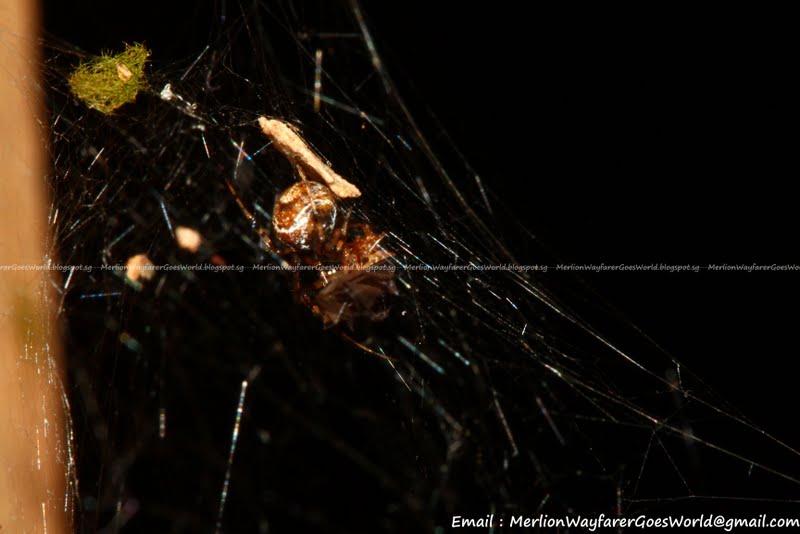
Merlion Wayfarer finds orb-weavers like the Malabars make very good photo subjects - when you can catch them at the right angle or if they are hungry enough...

Nephilengys Malabarensis (Malabar Spider), Lower Peirce Reservoir, September 2012 & Opadometa Fastigata (Pear-Shaped Leucauge) Spider, Dairy Farm, February 2013

Opiliones (Harvestmen)

           
It is only today that Merlion Wayfarer that technically, certain sources are not regarding some species of Daddy Long Legs as spiders. However, they still belong to the Arachnida class - Arachnids, or rather, joint-legged invertebrate animals with 8 legs.

Hmmm, why are they not spiders?
  • Spiders' bodies consist of two parts - the cephalothorax and the abdomen. Certain Daddy Long Legs have their heads, thoraxes, and abdomens all fused together
Araneidae (Orb-Weaver) Spider, Lower Peirce Reservoir, September 2012

Tetragnatha Mandibulata (Common Big-Jawed Spider), Punggol Park Connector, 20 August 2012

  • Instead of the spider's usual eight eyes, these Daddy Long Legs have just two. And these two are located about 1/4 down their bodies instead of at the top of their heads.
Harvestman, Lower Peirce Reservoir Park, March 2012
  
It was hard to spot today's Harvestman among the trees and shrubs at Lower Peirce. This was what caught Merlion Wayfarer's eye at first - some dangling "threads" on a tree trunk...


Look how it can embed its body into the crevices in the trunk!

The proportion of its legs is 10x the length of its body!

The Others

 
A few other interesting sights that Merlion Wayfarer chanced upon:
  • A grasshopper embroiled in a webbed leaf...

  • These little ones - Macronous Gularis (Pin-Striped Tit Babblers) - having some fun in the thistle...
    [Thanks for the ID, Hanno]

  • A whole family of squirrels were around near the water edge - jumping from tree to tree and chirping merrily. This is the smaller Sundasciurus Tenuis (Slender Squirrel), which has big melty puppy dog eyes and looks relatively more adorable than its Callosciurus Notatus (Plantain Squirrel) cousin, which is distinguished by an orange belly. 
Right - Callosciurus Notatus (Plantain Squirrel), Ang Mo Kio Town Garden West, August 2012 

  • By the water's edge, a pair of Pseudagrion Microcephalum (Blue Sprite) are in love...


The full albums are available at:


Sources