The Flying Saucer At Sunset

Lenticular clouds (Altocumulus lenticularis) are stationary lens-shaped clouds with a smooth layered appearance that form in the troposphere, usually above mountain ranges. One was spotted in Singapore recently...

Eyes Of 30,000 Honeycombs

With 30,000 individual facets, dragonflies have the most number of facets among insects. Each facet, or ommatidia, creates its own image, and the dragonfly brain has eight pairs of descending visual neurons to compile those thousands of images into one picture...

A Kaleidoscope Of Colours, Shapes And Patterns

Spectacular and innovative in design, the Flower Dome replicates the cool-dry climate of Mediterranean regions like South Africa, California and parts of Spain and Italy. Home to a collection of plants from deserts all over the world, it showcases the adaptations of plants to arid environments...

Lightning Strikes, Not Once, But Many Times

Unlike light, lightning does not travel in a straight line. Instead, it has many branches. These other branches flashed at the same time as the main strike. The branches are actually the step leaders that were connected to the leader that made it to its target...

Are You My Dinner Tonight?

A T-Rex has 24-26 teeth on its upper jaw and 24 more on its lower jaw. Juveniles have small, sharp blade-shaped teeth to cut flesh, whereas adults have huge, blunt, rounded teeth for crushing bones. Is the T-Rex a bone-crushing scavenger?

Showing posts with label Moon. Show all posts

The Day After The Full Moon

Singapore
15 February 2014
 
14 February 2014 was the night of the full moon. It was also the night of the Chinese Valentine's Day, falling on the 15th day of the Lunar New Year.
 
The day after the full moon was one full of clouds. For an usually cloudy and windy February, wisps of dark clouds covered a still very bright moon, dulling its pale lemon glow...


More photos are available on Merlion Wayfarer Goes Green's Picasa at :
Natural Phenomena - The Moon


The Moon Will Not Set On 05 February 2014

Singapore
05 February 2014

This a photo of the 0.22 fraction crescent moon at 2230 hours (1030 pm) before it sets.


Huh... a moon sets at night? Doesn't it follow the cycle of the sun?
 
Apparently not.
 
According to the moonrise and moonset chart by the National Environment Agency (NEA), the moon rises and sets everyday.
 
(Source : NEA)

Well, almost.
 
If you notice, that something interesting is going to occur on 05 February 2014 - There is a "NIL" for moonset time. The moon will not set on that day.
 
Why?
 
This is because the moon rises on 1142 hours on 05 February 2014. With a set time of 12 hours and 25 minutes away, it is expected to set at 0008 hours, which falls on the next day, 06 February 2014.
 
So, the truth holds that...
The Moon Will Not Set On 05 February 2014
 

More photos are available on Merlion Wayfarer Goes Green's Picasa at :
Natural Phenomena - The Moon


New Moon Shining Through

Singapore
10 August 2013

A new moon shining through with the Earth casting a shadow over it...


More photos are available on Merlion Wayfarer Goes Green's Picasa at :
Natural Phenomena - The Moon


Moon No Blue Enough

Singapore
20 August 2013

Merlion Wayfarer read from Earth Sky that the moon on these two nights will be blue. 

There are different definitions for Blue Moon. By popular acclaim, Blue Moon refers to the second of two full moons in a single calendar month. A Blue Moon might also be the third of four full moons in a single season – a season being defined as the time period between a solstice and an equinox, or vice versa. Or, someday, you might see an actual blue-colored moon. A Blue Moon falls on the night of August 20-21, 2013. It’s a Blue Moon by the seasonal definition, that is, the third of four full moons to take place in a season, in this case between the June 2013 solstice and September equinox. The last Blue Moon by this definition happened on November 21, 2010.

This is the moon last night - the first shot was taken with Auto White Balance and the second one was taken with the Daylight mode, which more accurately reflects the colour of the moon...

Definitely no blue enough. Oh well, Merlion Wayfarer will be on the lookout again tonight!


More photos are available on Merlion Wayfarer Goes Green's Picasa at :
Natural Phenomena - The Moon


Sources


Hello Moon Halos!

Singapore
August 2013

There were two rainbow-tinted rings around the moon last night. - TWO!


The rings that encircled the moon arose from light passing through six-sided ice crystals high in the atmosphere. These ice crystals refract, or bend, light in the same manner that a camera lens bends light. The crystals have to be oriented and positioned just so with respect to your eye, in order for the halo to appear. The ring has a diameter of 22° , and sometimes, a second ring, 44° diameter, forms. 

Thin high cirrus clouds lofting at 20,000 feet or more contain tiny ice crystals that originate from the freezing of super cooled water droplets. These crystals behave like jewels refracting and reflecting in different directions. Cloud crystals are varieties of hexagonal prisms, (6 sides) and range in shapes from long columns to thin plate-like shapes that have different face sizes.

(Source : Keith's Moon Page)

That’s why, like rainbows, halos around the sun - or moon - are personal. Everyone sees their own particular halo, made by their own particular ice crystals, which are different from the ice crystals making the halo of the person standing a short distance away. 

Hmmm that explains why, despite Singapore's small size, 
a moon halo in Changi may not be visible by someone staying in Jurong...
(Source : NEA)

Folklore has it that a ring around the moon signifies bad weather is coming. It is believed that the number of stars within a moon halo indicate the number days before bad weather will arrive. 

Ok, there were zero stars around the two halos.

A while later, the sky completed cleared up and the craters on the moon can be seen clearly.


So how can rings around the moon be a predictor of weather to come? The ice crystals that cover the halo signify high altitude, thin cirrus clouds that normally precede a warm front by one or two days. Typically, a warm front will be associated with a low pressure system which is commonly referred to as a storm.

True enough, this was the sky this morning...


With this weather forecast for the next 12 hours...

(Source : NEA)


More photos are available on Merlion Wayfarer Goes Green's Picasa at :
Natural Phenomena - Clouds and Natural Phenomena - The Moon


Sources


June 2013's Super Moon

Singapore
24-25 June 2013

The night of 24 June 2013 saw the rise of the super moon. This full moon was not only the closest and largest full moon of the year. It was also the moon’s closest encounter with Earth for all of 2013. The moon will not be so close again until August 2014. In other words, it was not just a supermoon. It was the closest supermoon of 2013.

Cheezels super moon in haze, 24 June 2013, 1953h...

Super moon, 24 June 2013, 2205h...

Salted egg yolk super moon, PSI 60+, 25 June 2013, 0643h...


More photos are available on Merlion Wayfarer Goes Green's Picasa at :
Natural Phenomena - The Moon


Sources

A Red Billowing Thunderhead

Singapore
17 July 2013

In a clear sky with some stars and a smattering of alto (mid-level) clouds, the half-moon tonight shone bright and whitish-clear.  


In the distant western sky, there was a huge billowing cloud of at least 6-storeys high. At first glance, it appeared as if a house was on fire. But the ominous red billow stood unchanged for more than half an hour with no visible  flickering light in the horizon.


This is a thunderhead - a towering cumulus cloud.

Rather than spreading out in bands at a fairly narrow range of elevations, like other clouds, cumulus and cumulonimbus clouds rise to dramatic heights, sometimes well above the level of transcontinental jetliner flights.

Cumulus clouds are fair-weather clouds. When they get big enough to produce thunderstorms, they are called cumulonimbus, or thunderheads. These clouds are formed by upwelling plumes of hot air, which produce visible turbulence on their upper surfaces, making them look as though they are boiling. 

The convective airmass is  highly unstable. Just as it takes heat to evaporate water from the surface of the Earth, heat is released when water condenses to form clouds. In thunderheads, this energy can produce short-lived hail, damaging winds, lightning, torrential rain, and sometimes tornadoes. The top of the cloud points in the direction the weather is moving towards.

True enough, this is NEA's weather prediction for the next 12 hours:


More photos are available on Merlion Wayfarer Goes Green's Picasa at :
Natural Phenomena - Clouds and Natural Phenomena - The Moon


Sources


The Seas Of Tranquility And Serenity In The Haze

Singapore
19 June 2013

On this night when the PSI still remains high and is escalating as we approach early morning, Merlion Wayfarer was surprised to note that the moon is bright and clear. Tonight is the 11th night of the lunar calendar, 4 days away from the monthly full moon.

PM10 PSI reading as of 0000h. The upward trend started around 2000h...

What we are seeing here is the "near side" of the moon, distinguishable by presence of dark spots called "lunar maria". The side of the Moon that faces Earth is called the near side, and the opposite side the far side.  

Lunar maria are formed by ancient volcanic eruptions, and are found almost exclusively on the near side of the Moon, covering 31% of the surface on the near side, compared with a few scattered patches on the far side covering only 2%.

Even from this distance, the Seas of Tranquility and Serenity are visible...

Merlion Wayfarer looks forward to good weather and clearer skies on the 15th.


More photos are available on Merlion Wayfarer Goes Green's Picasa at :Natural Phenomena - The Moon


Sources

  • "Lunar mare". Wikipedia. Retrieved from http://en.wikipedia.org/wiki/Lunar_mare (19 June 2013).
  • "Moon" by SPUDIS, P.D. (2004).  World Book Online Reference Center, NASA. 
  • "Moon". Wikipedia. Retrieved from http://en.wikipedia.org/wiki/Moon (19 June 2013).
  • "The Composition and Geologic Setting of Lunar Far Side Maria" by GILLIS, J.J. & SPUDIS, P.D. (1996). Lunar and Planetary Science, 27: 413–404.
       

Red Moon Rising

Singapore
June 2013

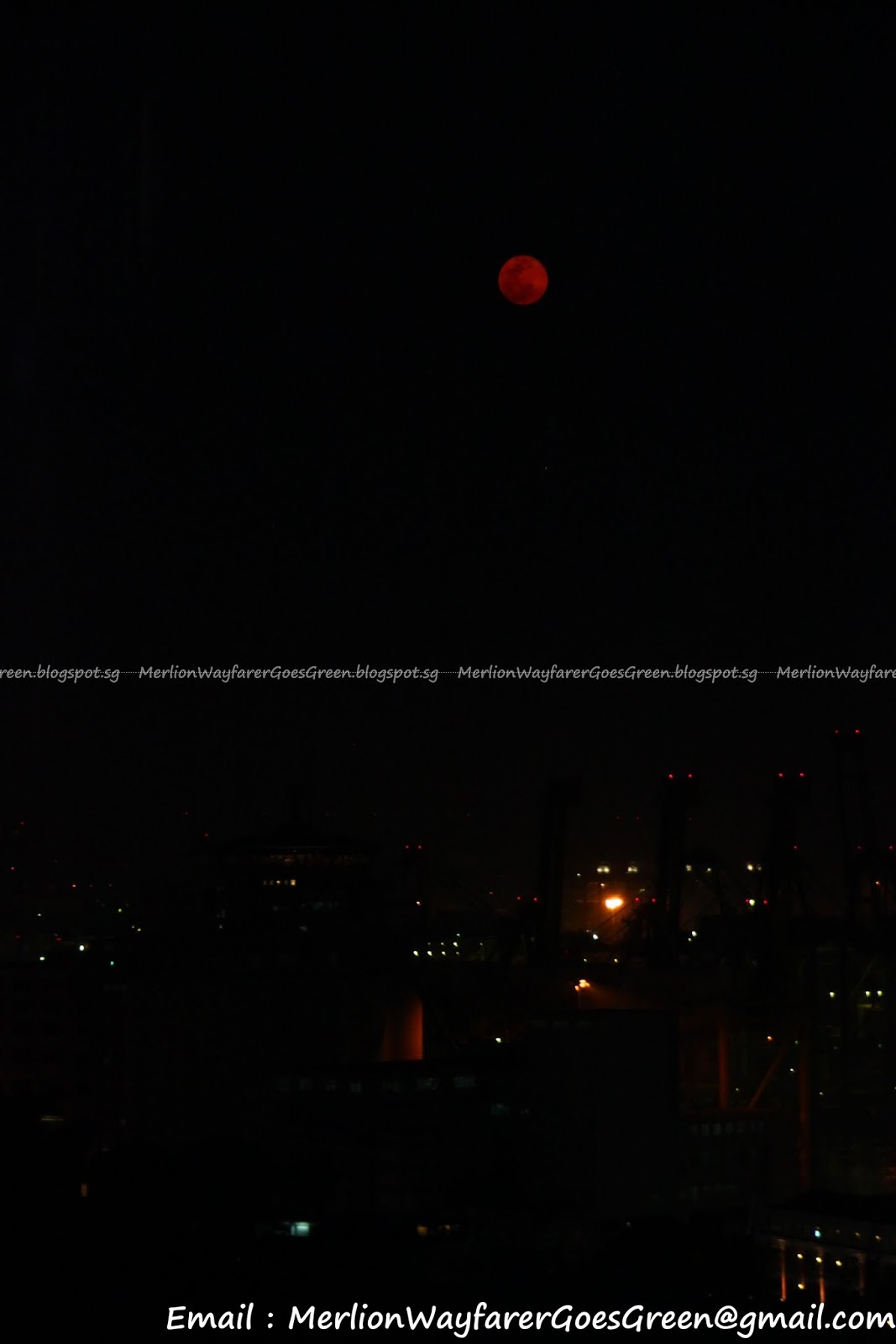
It was Thursday the 13th. Merlion Wayfarer looked out of her window and spotted a red moon. Incredulous, she blinked. And looked out again. A red moon.

(13 June 2013, 2150 hours)

She had never seen a red moon before - White yes, Yellow yes, Orange yes, Red no.

Moments later, the moon was obscured by the dark clouds. All that remained was one dark sky. Pitch black.

Uh-oh.

Her religious friends were filled with premonitions.


Instead of scaring herself silly, Merlion Wayfarer looked to Google for a scientific explanation...
Most of the time, the Moon is a bright yellow color; it’s reflecting light from the Sun. But sometimes the Moon can turn a beautiful dramatic red color.

There are few situations that can cause a red moon.

The most common way to see the Moon turn red is when the Moon is low in the sky, just after moonrise or before it’s about to set below the horizon. Just like the Sun, light from the Moon has to pass through a larger amount of atmosphere when it’s down near the horizon, compared to when it’s overhead. The Earth’s atmosphere can scatter sunlight, and since moonlight is just scattered sunlight, it can scatter that too. Red light can pass through the atmosphere and not get scattered much, while light at the blue end of the spectrum is more easily scattered. When you see a red moon, you’re seeing the red light that wasn’t scattered, but the blue and green light have been scattered away. That’s why the Moon looks red.

The second reason for a red moon is if there’s some kind of particle in the air. A forest fire or volcanic eruption can fill the air with tiny particles that partially obscure light from the Sun and Moon. Once again, these particles tend to scatter blue and green light away, while permitting red light to pass through more easily. When you see a red moon, high up in the sky, it’s probably because there’s a large amount of dust in the air.

A third - and dramatic - way to get a red moon is during a lunar eclipse. During a lunar eclipse, the Moon passes behind the Earth’s shadow, which darkens it. If you could take a look at the Earth from inside its shadow, you would see that the atmosphere around the edge of the entire planet glows red. Once again, this is because large amounts of atmosphere will scatter away the blue/green light and let the red light go straight through. During a lunar eclipse, the Moon passes fully into the shadow of the Earth and it’s no longer being illuminated by the Sun; however, this red light passing through the Earth’s atmosphere does reach the Moon, and shines on it.

(Source : Universe Today)
Hmmm, #3 is unlikely as there was no lunar eclipse forecasted on 13 June 2013. The last lunar eclipse was on 25 May 2013. The next lunar eclipse is on 18 October 2013. (Space.com, 2013)

The Moon's eastward motion is much slower than the sky's westward motion. So, though moving to the east from day to day, it still has a net motion toward the west, each day. This means that it still rises in the east, and sets in the west, like the stars, but a little later, each day. 

(Source : CSeligman.com)

Despite a forecast of an earlier moonset at 2249 hours on 13 June, the crescent moon was yellow on both 12 June and 14 June.

(Source : NEA)

Hence, the most likely reason was dust particles in the atmosphere.

"The exact color that the moon appears depends on the amount of dust and clouds in the atmosphere," according to NASA scientists. "If there are extra particles in the atmosphere, from say a recent volcanic eruption, the moon will appear a darker shade of red." (Space.com, 2013)

(Source : Ngabo)

Merlion Wayfarer recalled that the PSI reading from Wednesday was at 59. On Friday, it jumped to 91. The 24h reading shows a high degree of particulate matter (PM2.5 and PM10). It was also an unusually warm evening with still air on 13 June, an indication of wind shift.

(Source : NEA)

A check on the NEA website confirms this:
Hazy Conditions Update
(Updated on 14 June 2013)

Southwest Monsoon conditions have onset over the region since the beginning of the week, with low level winds blowing predominantly from the southeast or southwest. The Southwest Monsoon season typically last from June to September and is the traditional dry season for the southern ASEAN region.

In the coming months, occasional extended periods of drier weather can be expected in the region. During the season, increased hotspot activities may be expected in Sumatra and Borneo. In addition, transboundary smoke haze could affect the region during periods of persistent dry weather conditions.

In recent days, weather conditions in the region have become drier and an increase in hotspot activities has been observed mainly over central Sumatra.  85 hotspots were detected on 6 June 2013 over Sumatra. Due to more cloud cover over Sumatra yesterday, the number of hotspots detected on 13 June 2013 has decreased to 22.   Singapore was affected by slight haze since yesterday.  The haziness and burning smell are from the fires in Sumatra, brought over by prevailing winds blowing from the southwest or west during the current Southwest Monsoon season. Hazy conditions are expected for the next few days.

(Source : NEA)

More photos are available on Merlion Wayfarer Goes Green's Picasa at :
Natural Phenomena - The Moon


Sources