The Flying Saucer At Sunset

Lenticular clouds (Altocumulus lenticularis) are stationary lens-shaped clouds with a smooth layered appearance that form in the troposphere, usually above mountain ranges. One was spotted in Singapore recently...

Eyes Of 30,000 Honeycombs

With 30,000 individual facets, dragonflies have the most number of facets among insects. Each facet, or ommatidia, creates its own image, and the dragonfly brain has eight pairs of descending visual neurons to compile those thousands of images into one picture...

A Kaleidoscope Of Colours, Shapes And Patterns

Spectacular and innovative in design, the Flower Dome replicates the cool-dry climate of Mediterranean regions like South Africa, California and parts of Spain and Italy. Home to a collection of plants from deserts all over the world, it showcases the adaptations of plants to arid environments...

Lightning Strikes, Not Once, But Many Times

Unlike light, lightning does not travel in a straight line. Instead, it has many branches. These other branches flashed at the same time as the main strike. The branches are actually the step leaders that were connected to the leader that made it to its target...

Are You My Dinner Tonight?

A T-Rex has 24-26 teeth on its upper jaw and 24 more on its lower jaw. Juveniles have small, sharp blade-shaped teeth to cut flesh, whereas adults have huge, blunt, rounded teeth for crushing bones. Is the T-Rex a bone-crushing scavenger?

A Red Billowing Thunderhead

Singapore
17 July 2013

In a clear sky with some stars and a smattering of alto (mid-level) clouds, the half-moon tonight shone bright and whitish-clear.  


In the distant western sky, there was a huge billowing cloud of at least 6-storeys high. At first glance, it appeared as if a house was on fire. But the ominous red billow stood unchanged for more than half an hour with no visible  flickering light in the horizon.


This is a thunderhead - a towering cumulus cloud.

Rather than spreading out in bands at a fairly narrow range of elevations, like other clouds, cumulus and cumulonimbus clouds rise to dramatic heights, sometimes well above the level of transcontinental jetliner flights.

Cumulus clouds are fair-weather clouds. When they get big enough to produce thunderstorms, they are called cumulonimbus, or thunderheads. These clouds are formed by upwelling plumes of hot air, which produce visible turbulence on their upper surfaces, making them look as though they are boiling. 

The convective airmass is  highly unstable. Just as it takes heat to evaporate water from the surface of the Earth, heat is released when water condenses to form clouds. In thunderheads, this energy can produce short-lived hail, damaging winds, lightning, torrential rain, and sometimes tornadoes. The top of the cloud points in the direction the weather is moving towards.

True enough, this is NEA's weather prediction for the next 12 hours:


More photos are available on Merlion Wayfarer Goes Green's Picasa at :
Natural Phenomena - Clouds and Natural Phenomena - The Moon


Sources


Eyes Of 30,000 Honeycombs

Lower Peirce
North, Singapore
July 2013

Merlion Wayfarer spotted a Brachydiplax Chalybea (Blue Dasher) dragonfly perched on a twig. A few shots were taken with this very accommodating subject. On zooming, she realized that those few shots had managed to capture a very important facet of a dragonfly's anatomy - its compound eyes.


Thousands Of Honeycombs

 
Most insects have multi-faceted "compound eyes". For example, houseflies have about 6,000 eye facets that give them a panoramic view of their surroundings. These eyes look like honeycombs when viewed up close. 

With 30,000 individual facets, dragonflies have the most number of facets among insects. Each facet, or ommatidia, creates its own image, and the dragonfly brain has eight pairs of descending visual neurons to compile those thousands of images into one picture.


Compound eyes fall into two groups: apposition eyes, which form multiple inverted images, and superposition eyes, which form a single erect image. These eyes are common in arthropods, and are also present in annelids and some bivalved molluscs. In arthropods, compound eyes, grow at their margins by the addition of new ommatidia.

What's The Big Deal About Compound Eyes?
   

The compound eye consists of thousands of individual photoreceptor units or ommatidia (ommatidium, singular). 

Each ommatidium consists of:
  • A lens (the front surface of which makes up a single facet)
  • A transparent crystalline cone
  • Light-sensitive visual cells arranged in a radial pattern like the sections of an orange
  • Pigment cells which separate the ommatidium from its neighbors.


The pigment cells ensure that only light entering the ommatidium parallel (or almost so) to its long axis reaches the visual cells and triggers nerve impulses. Thus each ommatidium is pointed at just a single area in space and contributes information about only one small area in the field of view.

The dragonfly's compound eyes consist of a series of bigger ommatidia (the red portion) occupying about 40% of each eye with finer ommatidia making up the rest of the lower portion...

The image perceived is a combination of inputs from the numerous ommatidia (individual "eye units"), which are located on a convex surface, and pointing in slightly different directions. The composite of all their responses is a mosaic image - a pattern of light and dark dots rather like the halftone illustrations in a newspaper or magazine. And just as in those media, the finer the pattern of dots, the better the quality of the image.

(Source : Elise Fallson)

Grasshopper eyes, with relatively few ommatidia must produce a coarse, grainy image. The honeybee and dragonfly have many more ommatidia and a corresponding improvement in their ability to distinguish detail. Even so, the resolving ability of the honeybee eye is poor in comparison with that of most vertebrate eyes and only 1/60 as good as that of the human eye; that is, two objects that we could distinguish between at 60 feet (18 m) could only be discriminated by the bee at a distance of one foot (0.3 m).

Compared with simple eyes, due to their sheer number of ommatidium and shape, compound eyes encompass a very large view angle, can detect fast movement, and in some cases, the polarisation of light. As an object moves across the visual field, ommatidia are progressively turned on and off. Because of the resulting "flicker effect", insects respond far better to moving objects than stationary ones. Honeybees, for example, will visit wind-blown flowers more readily than still ones.

With prey snagged in its jaws...

Compound eyes are especially adept at "locking on" to anything that is moving quickly. Like a heat-seeking missile, when a honey bee sees a fast-moving object, its attention is "locked" and an alarm goes off in the honey bees' colony protective instincts. This explains why experienced bee keepers hark on the importance of slow and careful movements in the apiary.

(Source : Laser Focus World)

Imagine a tennis player having to pick out a small ball from the crowd when the ball is traveling at almost 200kmh - selective attention is needed to hit that ball back into play. Likewise, the dragonfly hunts for insects which may exist in swarms - a collection of fast-moving tiny objects. Yet once it has selected a target, its neuron activity filters out all other potential prey. It then swoops in on its prey and gets it right 97% of the time.

Any Limitations?
  

Because the individual lenses are so small, the effects of diffraction impose a limit on the possible resolution that can be obtained (assuming that they do not function as phased arrays). This can only be countered by increasing lens size and number. To see with a resolution comparable to our simple eyes, humans would require ridiculously large compound eyes, around 11 m in radius.

The spherical field of vision means that dragonflies are still watching you after they have flown by. However, the backward-looking part of the eye has rather low resolution. This means that dragonflies and bees are less responsive to predators which attack from behind.


In dim light, an optical system needs to collect more light in order to see clearer. In general insects especially those diurnal ones are limited by the small apertures of each ommatidium in the compound eye, hence detect weak contrast especially in bright daylight or dim light. And in order to survive the insect eyes collect lights for about 0.1 second to form a given image. However for dragonflies, they may have apposition eyes with wider facets and they may collect light over a longer period (up to 0.5 seconds) before integrating the signal to produce the final image.

Dusk-active dragonflies have sacrificed most of their color vision in favor of increased light-collecting capacity by having fewer, larger facets in their eyes. They also lack all color sensitive opsins except green, which provides the broadest range of light sensitivity for any opsin. As a result, these dragonfly species probably also have a corresponding decrease in overall color perception.

More Eyes?!


But wait... A dragonfly has more than 2 eyes!


Dorsal ocelli are light-sensitive organs found on the dorsal (top-most) surface or frontal surface of the head of many insects. They coexist with the compound eyes, thus most insects possess two anatomically separate and functionally different visual pathways.

The number, forms, and functions of the dorsal ocelli vary markedly throughout insect orders. They tend to be larger and more strongly expressed in flying insects (particularly bees, wasps, dragonflies and locusts), where they are typically found as a triplet. Two lateral ocelli are directed to the left and right of the head, respectively, while a central (median) ocellus is directed frontally. In some terrestrial insects (e.g. some ants and cockroaches), only two lateral ocelli are present: the median ocellus is absent. The unfortunately labelled "lateral ocelli" here refers to the sideways-facing position of the ocelli, which are of the dorsal type. They should not be confused with the lateral ocelli of some insect larvae.

One common theory of ocellar function in flying insects holds that they are used to assist in maintaining flight stability. Given their underfocused nature, wide fields of view, and high light-collecting ability, the ocelli are superbly adapted for measuring changes in the perceived brightness of the external world as an insect rolls or pitches around its body axis during flight. Other theories of ocellar function have ranged from roles as light adaptors or global excitatory organs, to polarization sensors and circadian entrainers.


More photos are available on Merlion Wayfarer Goes Green's Picasa at :

Sources


LG Optimus G - Amazing Clarity & Macro Perfection

Singapore
July 2013

After receiving the LG Optimus G ("LG Optimus G - A Lighter & Greener Phone") and excitedly using for some weeks, here are the results of Merlion Wayfarer's review!


What's cool:
  • Long battery life - Can last up to 3 days on basic usage!
  • Huge screen that's crystal clear with an amazing array of colours
  • Cool design - Merlion Wayfarer tested the black which looks really professional
  • 32GB of internal memory - No MicroSD card is required for light users!

What's not-so-cool (Just 1!):
  • The wifi has to be manually reconnected every time the signal is dropped

Here are the photos from Merlion Wayfarer's hand-on testing:

Photos captured from other mobile devices are surprisingly clear - Here's the one from a tablet...

And one from another mobile phone - at an even closer distance...

That's how a S$10 note looks like to the LG Optimus G without zooming. 
The grains on the note are actually visible!

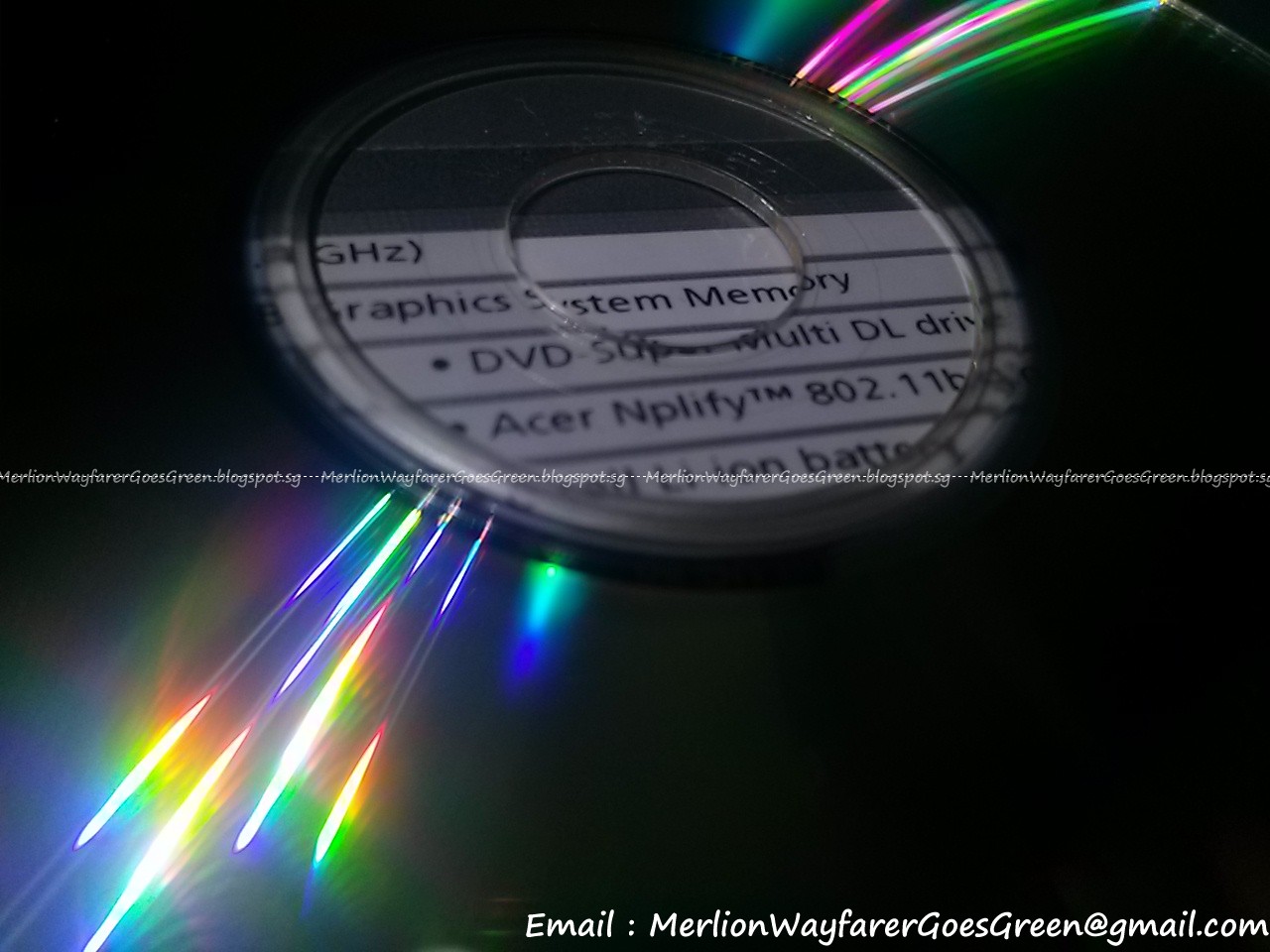
To show the colour spectrum, here's a macro shot of the light rays at the back of a CD...

Visibility against a white background is no issue - 
A bottle of correction fluid against a piece of paper...

For landscape shots, the Optimus G works well too:

A photo taken during the haze with the 13MP camera - 
The contrast is not overpowering despite the level of particles in the atmosphere...

A digital zoom with the camera at the same location - The foreground is still clear...

Merlion Wayfarer gives the thumbs up for this phone for great camera functions and long battery life!
(More information about the Optimus G - LG E975 can be found on LG Mobile.)

Thank you, LG & SPRG!


Related Reviews


More photos are available on Merlion Wayfarer Goes Green's Picasa at :

LG Optimus G Pro - Getting Blown Away!

Central Singapore
July 2013

Merlion Wayfarer was one of the 15 selected to enjoy the exclusive LG Optimus G Pro (E988) Fans Preview.


Having tested the LG Optimus G (E975), she was mighty impressed by the phone and had wanted to see what the Pro version could offer. And she was blown away!


Unlike the plastic cover set tested by some reviewers earlier, Merlion Wayfarer had the chance to experience one that has the professional-looking cover of the G (E975).  She likes the "glittering" look of the cool black checkered casing.
Eager reviewers enjoying themselves...

Thoughtful provision of delicious finger food while reviewers try out the food... 

Based on technical specifications alone, the G Pro impresses:
  • A 3,140 mAh battery
  • Full HD display
  • 13MP camera with geotagging, face detection, and image stabilization
  • 16GB eMMMC internal memory
  • Quad-Core 1.7GHz processor (This is faster than the processor of a basic laptop!)

Perfect for macros with its close focusing distance - Food never looked this good!

To the techno-sotongs, here's what's good:
  • Dazzling bright display that is crystal clear
  • Big - really big - and wide screen
  • A removable battery 
  • QuickMemo to allow you to scribble down a phone number on the screen of the phone if you are out of paper
  • Wireless charging without messy wires
  • A flashlight to be turned on for taking videos in low light conditions
  • Quick Translator which captures the text off the camera and syncs with Google Translate into the language you desire

There's something for sofa-loafers too:
  • See the game that you are playing projected onto the TV with a few simple taps.
  • No need to worry if your remote control is not working - QRemote 2.0 with embedded infrared technology allows the operation of multiple home devices, e.g. TV, DVD player, audio system.

Easy connectivity to TV for remote access and games...

Being a photographer, of course photo and video functions are very very very important to Merlion Wayfarer.
  • For times when she needs to take a self-portrait to show where she's been, the front camera is Full HD at 2.1 MP.
  • If she sees an interesting macro subject and does not have her DSLR with her, she can use the macro function which allows her to put the phone very near to the subject - More life-sized!
  • To put herself in the photo while holding the phone is no longer a constraint with the Dual Camera function.
  • The VR Panorama auto-captures the image as the phone is moved along. (No clicking required!) And it even captures images upwards and downwards!
    (Merlion Wayfarer really looks forward to owning this phone and testing it under outdoor and natural light settings for this function!)

The LG Optimus G Pro will be available in black and white at an RRP of S$868. More information can be found on LG Mobile.

Thanks for the privilege, LG!


Related Reviews
|   "LG Optimus G - A Lighter & Greener Phone"   |
|   "
LG Optimus G - Amazing Clarity & Macro Perfection"   |


More photos are available on Merlion Wayfarer Goes Green's Picasa at :

Megabugs Return! - Facing The Super-Sized

Science Centre Singapore 
Jurong East, Singapore
June 2013


The day that Merlion Wayfarer looked forward to has finally arrived. (See "Marvel At The Small Things In Life".) On a warm weekend afternoon, she stepped into the Science Centre and found her way to the Annexe.

Pausing at the entrance to MegaBugs Returns!, she took a deep breath. What will she expect to find?


In she goes into the Warp Tunnel...

And emerges the size of a 20-cent coin where the world of bugs is revealed to her...

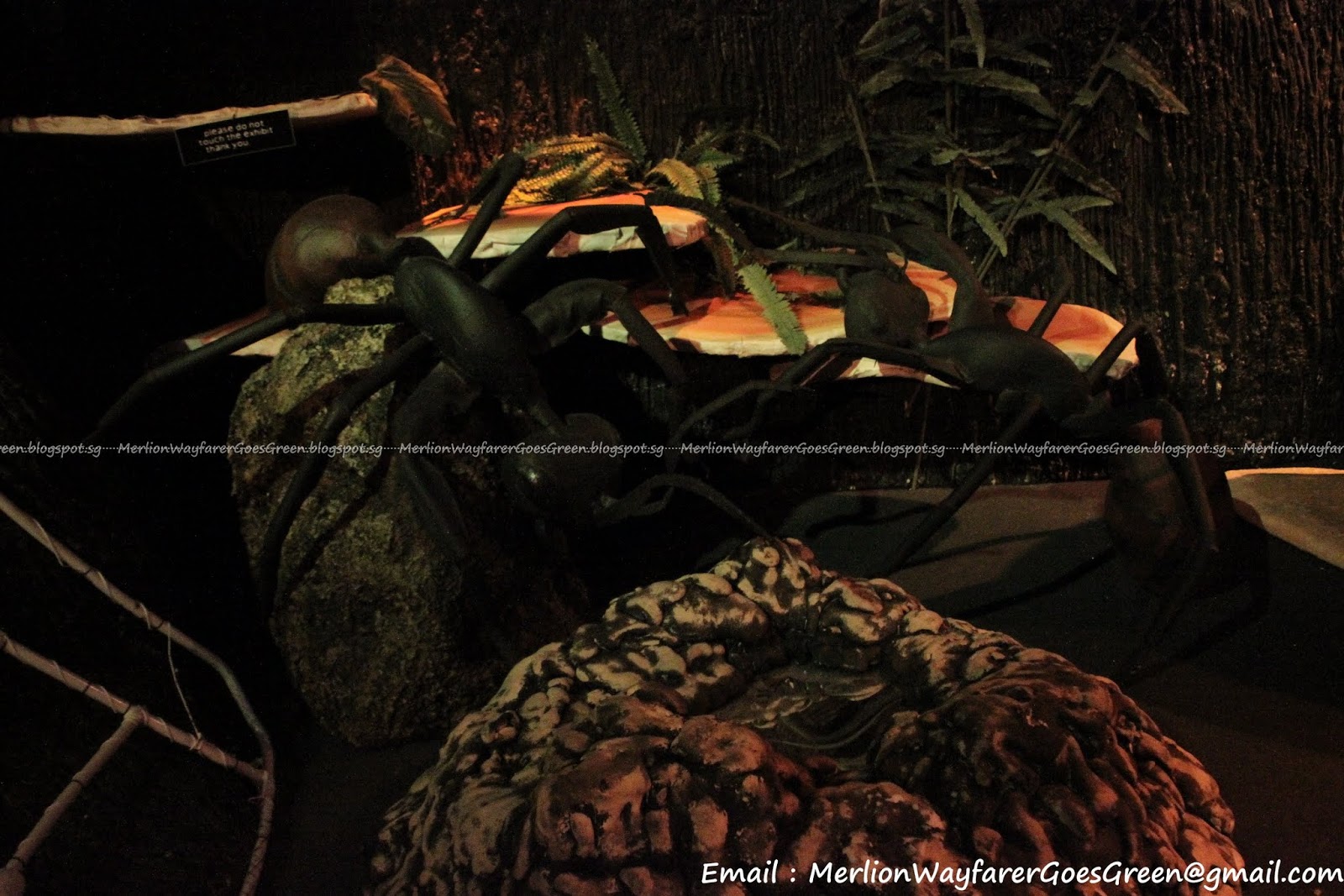
Curious ants swarmed around her, feelers twitching - some were milling around bits of biscuits and donuts left behind by some careless humans, others were protecting their nests...

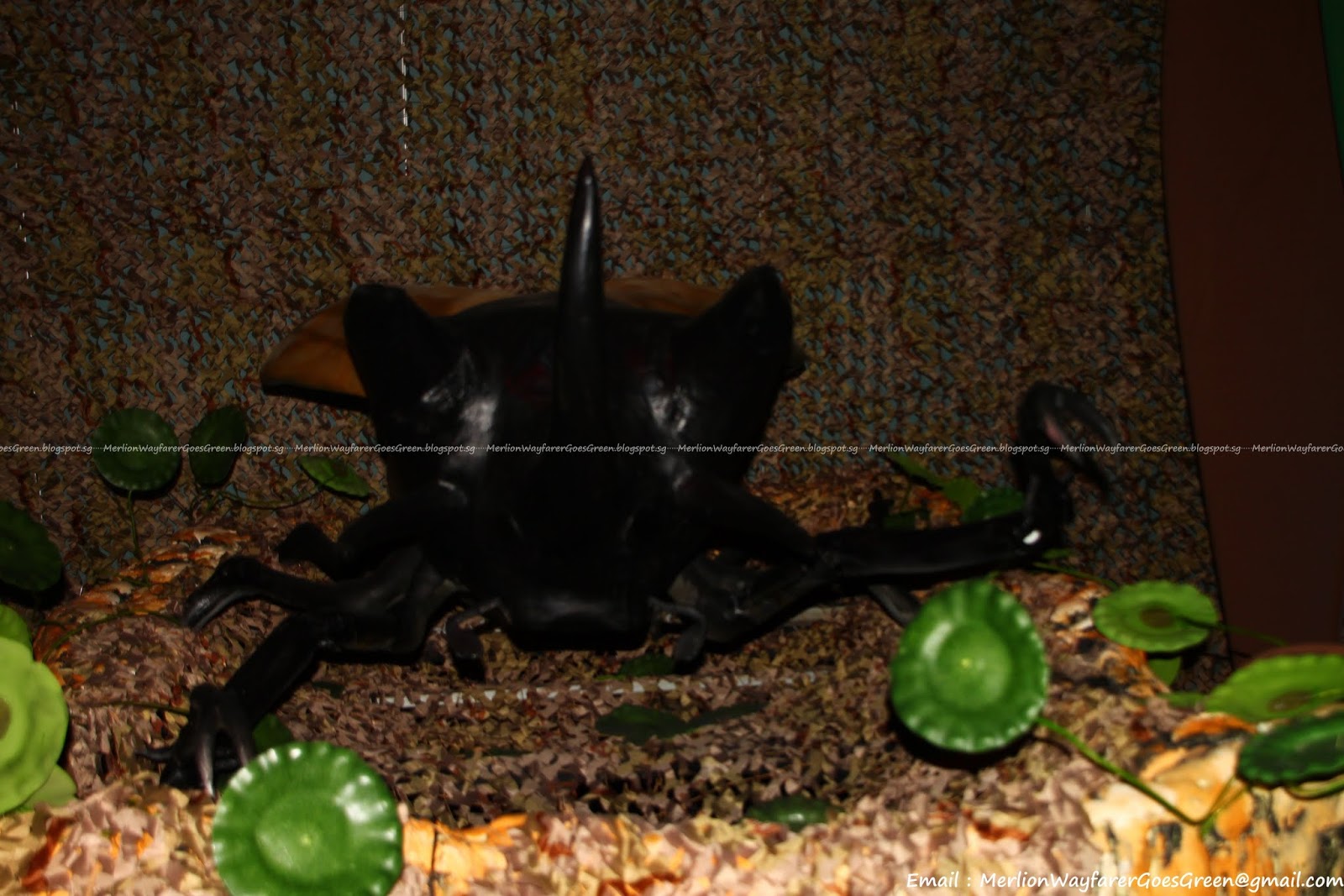
Mere steps away stood a gigantic Rhinoceros Beetle - its single horn glinting menacingly in the light. Although it usually uses this horn when fighting other males, Merlion Wayfarer is not taking her chances with this one!

What's that smell? It's actually coming from these beetles which have rolled some feces into a ball! These balls are used as a food source or breeding chambers...

Hey look! Why is that dragonfly moving in this weird way?

Merlion Wayfarer learnt that like all insects, dragonflies are technically ectotherms. That does not mean that they are at the mercy of Mother Nature to keep them warm or cool. Dragonflies that patrol (fly back and forth, versus those that tend to perch) will fire up their wings, using a rapid whirring movement to warm up their bodies. Perching dragonflies rely on solar energy for warmth, but position their bodies skillfully to maximize the surface area exposed to the sun's rays. Some even use their wings as reflectors, tilting them to direct the solar radiation toward their bodies. Conversely, during hot spells some dragonflies will position their bodies to minimize sun exposure, and use their wings to deflect the sun.

Look what's resting on some logs - A Monarch Butterfly on one side and a Common Rose a short distance away. Monarchs are famous for their migration patterns which last longer than the lifetime of a single generation...
 
A boy exclaims in surprise - Look at that human over there! She is even smaller than a housefly...
  
Watch out! There is a ferocious centipede on the loose! It looks headed for...
 
An angry scorpion! They must be headed for the housefly as dinner!

The snail watches the scene calmly, gliding by and leaving a trail of slime in its wake...

Nearby, on a blade of grass, a praying mantis is watching a grasshopper...
(To see the life cycle of a praying mantis, catch "Bugs! 3D – A RainForest Adventure", 
a documentary of the fascinating universe of insects magnified up to 250,000 times their normal size where a single raindrop can be as big as whole pond.)

What's this - A giant can of insecticide!

It must be used for spraying household pests like this American Cockroach...
 
And this mosquito...

And yes, the Aedes Mosquito with its striped legs can cause dengue (as this boy pointed out) 
so do keep your home free of stagnant water...

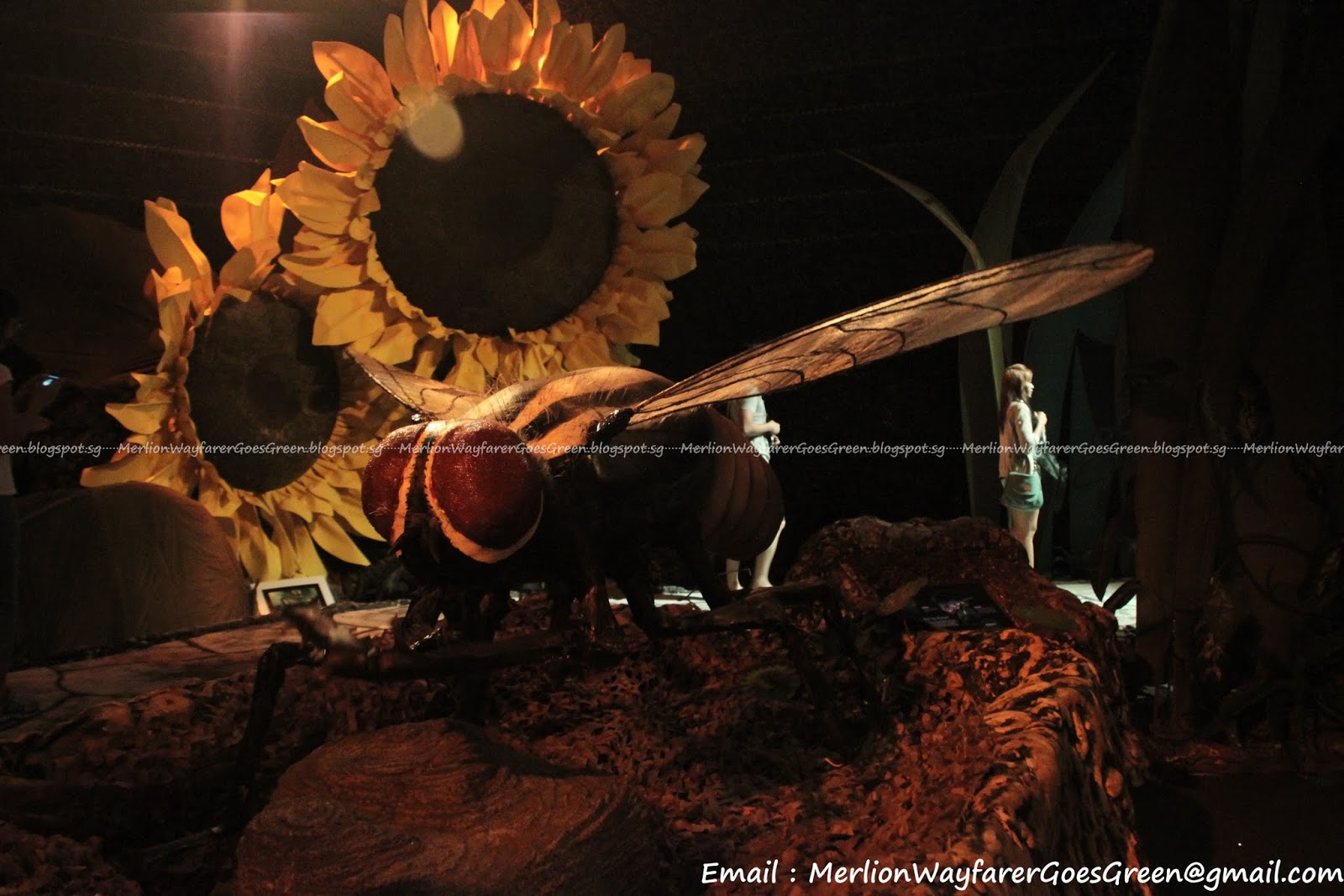
Stand off with a bee... Luckily it's not the side with the sting...

Taking a short break underneath the shelter of some leaves, Merlion Wayfarer spotted a few little humans enjoying some fun activities...

  • Pretending to be a fly on the wall...


  • Adding colours to ladybirds and butterflies...

  • Counting how many insects they can spot...
  •  Big humans teaching little humans how to identify insect calls...


  • Venturing into the cosy nest of a gigantic Singapore Blue Spider and reading Bugs Facts...
  • Learning how bugs communicate and how they can be useful to humans...


  • Figuring how a squirming little "worm" can end up as an insect with wings...
  • Most importantly, finding out what's a "bug" and what are the different types of bugs...

Seeing a light at the end of the tunnel, Merlion Wayfarer ventured into the bouncing forest path, 
her legs sinking knee-deep into the leaves...

With a blinding flash, she was back to her normal size at the Science Centre. What a relief!


She went on to explore the other activities for normal-sized humans outside the exhibition...
  • Good photo opportunities with more bugs - The dung beetle is a popular crowd favourite...
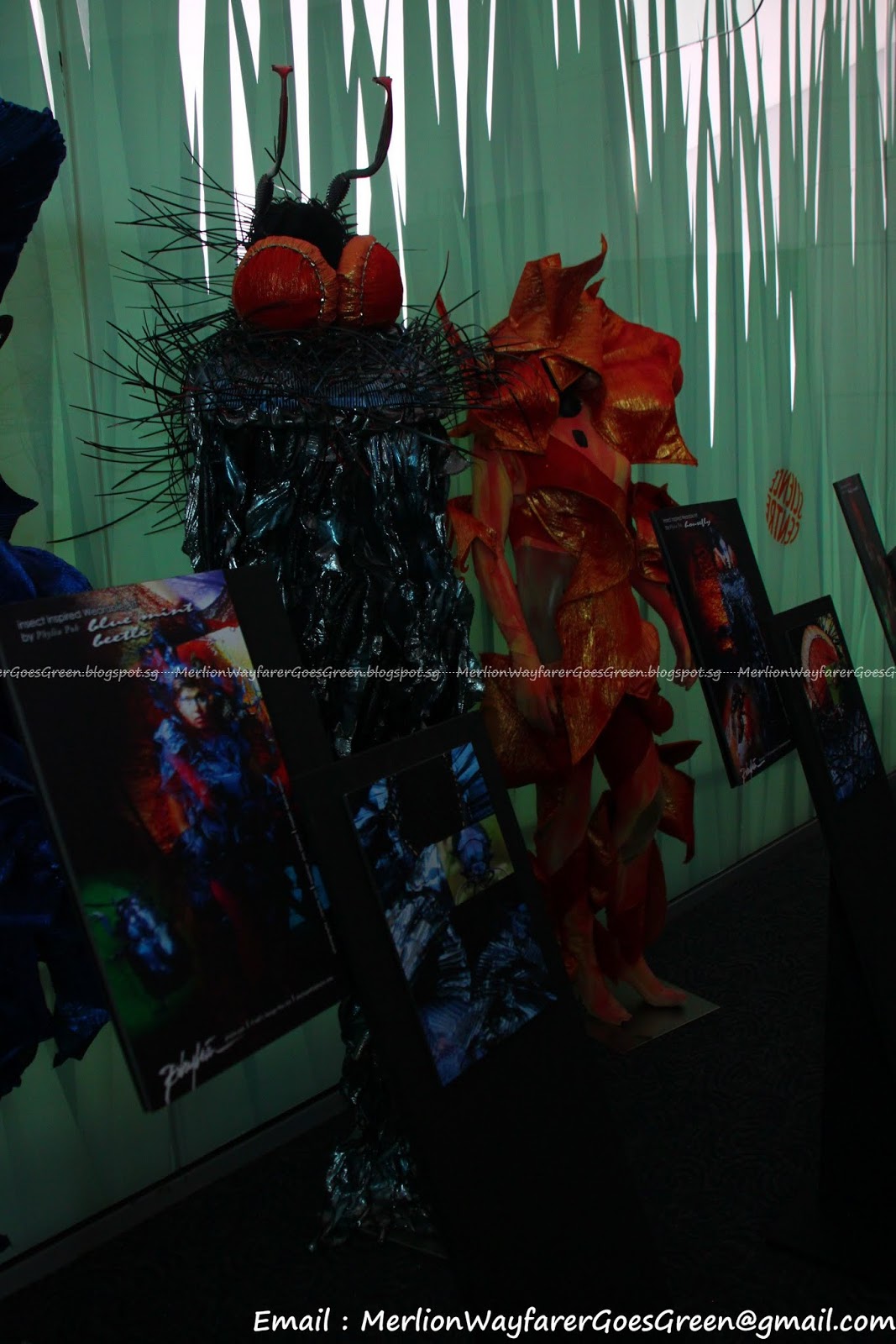
  • Normal-sized humans are able to try on the creative bug costumes designed by students from a secondary school...
  • Other fringe activities include do-it-yourself insect kits, clay-modelling and a studio photo setup...

The sun is setting, better head off home before the insects come alive at night!

Thank you, Science Centre Singapore and Golin Harris!

|   "Marvel At The Small Things In Life"   |   "Science For The Young And Young-At-Heart"   |
 

More photos are available on Merlion Wayfarer Goes Green's Picasa at :
Places - Science Centre