The Flying Saucer At Sunset

Lenticular clouds (Altocumulus lenticularis) are stationary lens-shaped clouds with a smooth layered appearance that form in the troposphere, usually above mountain ranges. One was spotted in Singapore recently...

Eyes Of 30,000 Honeycombs

With 30,000 individual facets, dragonflies have the most number of facets among insects. Each facet, or ommatidia, creates its own image, and the dragonfly brain has eight pairs of descending visual neurons to compile those thousands of images into one picture...

A Kaleidoscope Of Colours, Shapes And Patterns

Spectacular and innovative in design, the Flower Dome replicates the cool-dry climate of Mediterranean regions like South Africa, California and parts of Spain and Italy. Home to a collection of plants from deserts all over the world, it showcases the adaptations of plants to arid environments...

Lightning Strikes, Not Once, But Many Times

Unlike light, lightning does not travel in a straight line. Instead, it has many branches. These other branches flashed at the same time as the main strike. The branches are actually the step leaders that were connected to the leader that made it to its target...

Are You My Dinner Tonight?

A T-Rex has 24-26 teeth on its upper jaw and 24 more on its lower jaw. Juveniles have small, sharp blade-shaped teeth to cut flesh, whereas adults have huge, blunt, rounded teeth for crushing bones. Is the T-Rex a bone-crushing scavenger?

The Spiders Of Labour Day

Punggol Waterway
North East, Singapore
01 May 2014

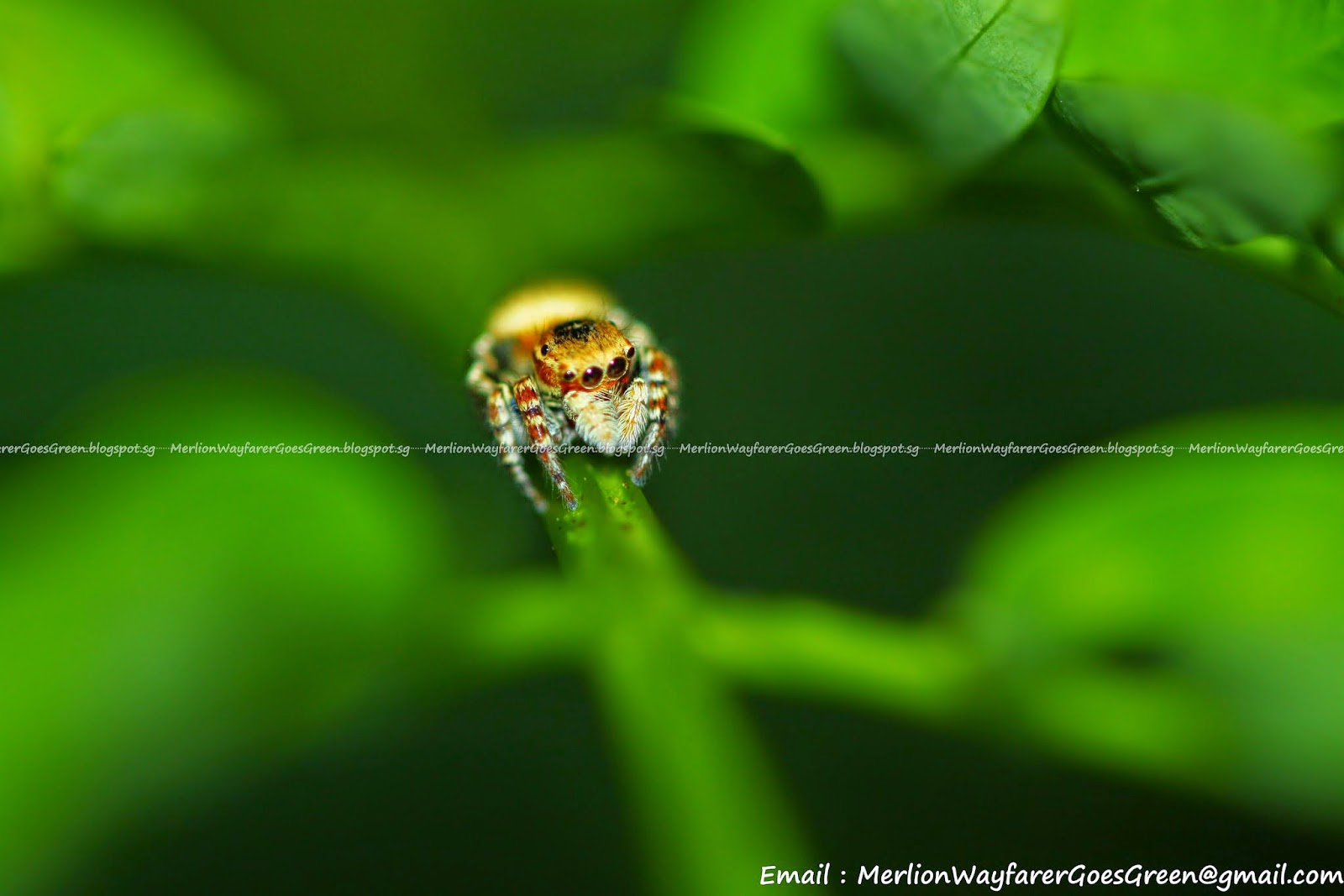
Labour Day was a day for spiders...

Oxyopidae (Lynx Spiders)

The family name, Oxyopidae, is derived from the Greek meaning sharp sighted with the colloquial name (lynx) refers to the catlike manner of prey capture. They are diurnal (active during the day) and arboreal (living on plants and trees) spiders usually found on shrubs, grasses and trees.

Oxyopids range from small to large spiders (5-25mm). Viewed head-on, the cephalic (head) area is high, with 6 of the 8 eyes arranged in a hexagonal formation with a large clypeus (area below eyes to the anterior edge of carapace). They use their excellent vision to pursue and pounce on prey. 

The flexibility of the Oxyopes  Birmanicus (Burmese Lynx) Spider's legs can be seen here 
- waving a leg above its head, tilted upwards between two leaves, gripping a leaf upside down...

Phintella Vittata (Banded Phintella)

Males and females of the species Phintella Vittata are able to detect ultraviolet light from the so-called UVB band (315-280 nm) and have specialized surfaces on their bodies to reflect it. The reflection of UVB radiation by males during courtship has been shown to enhance their ability to attract females.

A very active and curious female jumping from leaf to leaf. See her luminous green palps?

Her shiny silver carapace reflects ultraviolet light...

Tetragnathidae (Big-Jawed Spider)

Tetragnathidae are long-legged, thin-bodied spiders. When at rest, they cling lengthwise along a twig or blade of grass, holding on with the short third pair of legs with the long pairs of legs are extended. These spiders typically live near water and around the banks of waterways (rivers, lakes, swamps), usually on low-hanging branches and reeds.

A dormant Tetragnathidae lies stationary against a twig in the late afternoon as it awaits nightfall...

From certain angles, the stance is similar to that of Thomsidae (crab spiders) 
with the 2 elongated pairs of angled front legs...

Despite being orb weavers, Tetragnathidae are not usually found in their webs in the daytime. Nocturnal in lifestyle, they build or repair their webs only as night approaches... 


More photos are available on:


Tulipmania - Bringing A Mini Holland To Singapore

Gardens By The Bay
Marina Bay
South, Singapore
April 2014

Singapore’s largest popular tulip display - Tulipmania - is back at the Flower Dome at Gardens by the Bay from 14 April to 4 May 2014.


“Gardens by the Bay is proud to announce the second installation of Tulipmania  following last year’s success. We are delighted to have KLM Royal Dutch Airlines on board again to bring a slice of their heritage to our Gardens - with Miffy in tow this year." 
- Dr. Kiat W. Tan, Chief Executive Officer, Gardens by the Bay -


Tulipmania is part of the Europe leg of the “Gardens by the Bay Goes around the World” series of floral displays for 2014, bringing a “mini Holland” to Singapore. 
 
 
"Tulipmania is part of the exciting line-up of programmes designed to encourage people from all walks of life to enjoy the wonders of the plant kingdom in the Gardens.”
- Dr. Kiat W. Tan -


Blooms abound in the Flower Dome...

A typical Dutch landscape with townhouses, tulip fields, windmills and a Dutch cheese market greets visitors to Tulipmania. The miniature blue delft houses here are on loan from KLM roayal Dutch Airlines. These have been given as mementos to passengers on board KLM inter-continental Business Class flights since 1952...
 
The tulip display at the Flower Field resembles the beautiful city of Amsterdam, famed for its canals, tulip gardens and characteristic architecture that is truly Dutch...

Little touches that liven up the distinctly Dutch atmosphere...

Lots of people partake in the buoyant atmosphere of the Dutch landscape...

Tulipmania itself is an attraction to visitors to Singapore too...
 
Staff soaking in the atmosphere and doing a little fun jig amidst the blooms...

Inspired by Madurodam, a miniature park and tourist attraction in the Netherlands, the centrepiece will depict Dutch canal scenes, houses and windmills set amidst spectacular blooms of tulips and hyacinths. The star of the display will be the tulips flown in from the Netherlands, in a myriad of varieties and colours including red, yellow, orange, purple and white - all 50,000 of them - cool climate blooms airflown direct into the heart of our tropical climate. 


 Thank you, Gardens By The Bay...


More photos are available on Merlion Wayfarer Goes Green's Picasa at :
Gardens By The Bay


Lorong Halus - Among The Mangroves

Lorong Halus
East, Singapore
April 2014

As the sun sets, Merlion Wayfarer wandered among the mangroves at dusk...

In the dark, this Oxyopes birmanicus (Burmese Lynx Spider) seems well-hidden. 
The only telltale signs are the browns of its body against the stark white of the flowers...

A unique V-patterned moth (Heterocera) waits on a branch...

A bronze female Ligurra latidens (Mangrove Jumper) wanders about, hopping from stalk to stalk...


More photos are available on:


The Day After The Full Moon

Singapore
15 February 2014
 
14 February 2014 was the night of the full moon. It was also the night of the Chinese Valentine's Day, falling on the 15th day of the Lunar New Year.
 
The day after the full moon was one full of clouds. For an usually cloudy and windy February, wisps of dark clouds covered a still very bright moon, dulling its pale lemon glow...


More photos are available on Merlion Wayfarer Goes Green's Picasa at :
Natural Phenomena - The Moon