The Flying Saucer At Sunset

Lenticular clouds (Altocumulus lenticularis) are stationary lens-shaped clouds with a smooth layered appearance that form in the troposphere, usually above mountain ranges. One was spotted in Singapore recently...

Eyes Of 30,000 Honeycombs

With 30,000 individual facets, dragonflies have the most number of facets among insects. Each facet, or ommatidia, creates its own image, and the dragonfly brain has eight pairs of descending visual neurons to compile those thousands of images into one picture...

A Kaleidoscope Of Colours, Shapes And Patterns

Spectacular and innovative in design, the Flower Dome replicates the cool-dry climate of Mediterranean regions like South Africa, California and parts of Spain and Italy. Home to a collection of plants from deserts all over the world, it showcases the adaptations of plants to arid environments...

Lightning Strikes, Not Once, But Many Times

Unlike light, lightning does not travel in a straight line. Instead, it has many branches. These other branches flashed at the same time as the main strike. The branches are actually the step leaders that were connected to the leader that made it to its target...

Are You My Dinner Tonight?

A T-Rex has 24-26 teeth on its upper jaw and 24 more on its lower jaw. Juveniles have small, sharp blade-shaped teeth to cut flesh, whereas adults have huge, blunt, rounded teeth for crushing bones. Is the T-Rex a bone-crushing scavenger?

Sungei Buloh - The Dark Dangerous Branch

Sungei Buloh Wetland Reserve
North, Singapore
December 2013

A species of mangroves and coastal forests, the Cryptelytrops purpureomaculatus (Shore Pit Viper) has a reputation for being unpredictable and should be approached with caution. Giving no warning signs, this snake will strike readily and far at any threat, and its powerful haemotoxic venom can cause serious illness or even kill. 

This shy snake looks just like another branch in a mangrove tree where it usually coils motionless. A small snake with the typical broad triangular head of a viper, it has large red eyes on a rather angry looking face. It is more active at night.  By day it can be found resting on low branches one or two metres from the ground.


Its colour can vary from a uniform dark grey or purplish-brown to a weakly-patterned brown, with a white stripe along each flank, or even greenish-yellow with dark mottling. The scales are strongly keeled (i.e. ridged). Males grow to a total length of 66.5 centimetres (26.2 inches), females 90 centimetres (35 inches). The maximum tail lengths are then 12.5 centimetres (4.9 inches) and 14 centimetres (5.5 inches) respectively.


Feeding on lizards, frogs and other small animals, possibly small birds, similar to other vipers, it has heat-sensing pits on its lips to detect its prey.

Sources

Sentosa - A Billed Visitor

Sentosa
South, Singapore
March 2014

It was a normal hot weekend afternoon at Sentosa when Merlion Wayfarer was startled by a familiar but very unexpected cry from the trees. Looking among the trees above the KFC outlet at Imbiah Station, she spotted this very surprising sight - An Anthracoceros albirostris (Oriental Pied Hornbill) in the urban jungle next to the Resorts World Sentosa!


The Oriental Pied Hornbill disappeared from Singapore in the mid-1800s, possibly due to hunting and loss of suitable habitat. In 1994, a pair was recorded from Pulau Ubin. Once thought to be extinct in Singapore, the bird is re-establishing healthy colonies here, due in large to the collective efforts of the National Parks Board (NParks), Jurong Bird Park, and Singapore Avian Conservation Project (SACP). 

Good to see you enjoying the resorts here in Sentosa, Billed Visitor!


More photos are available on Merlion Wayfarer Goes Green's Picasa at : 
Aves - Bucerotidae (Hornbills)


Sengkang Park - That Thing With The Wayang Feelers

Sengkang Park
North East, Singapore
September 2013

Sengkang Riverside Park is located at Anchorvale Street and is situated alongside Sungei Punggol. The park is home to a unique water feature, a constructed wetland that collects and filters rainwater naturally through its aquatic plants. Despite its man-made features, the park contains a variety of fauna among its aquatic and terrestrial plants.

A well-camouflaged male Plexippus petersi (Common Housefly Catcher) Spider wanders on a tree trunk, gravity no obstacle to its upward climb...


Flitting among the stalks near the water were several male Crocothemis servilia (Common Scarlet) Dragonflies - Startling in their bright red colour...

A fascinating white-and-brown striped bug with wayang feelers three times its body length...

A silent stationary moth with glassy concussed eyes... 

Wandering about the pond was a Amaurornis phoenicurus (White-Breasted Waterhen)...

Lurking in the waters was a Varanus salvator (Water Monitor Lizard) cooling down after a hot day...


More photos are available on :


Bukit Timah Nature Reserve - Where Lizards Roam

Bukit Timah Nature Reserve
Central, Singapore
March 2014

Bukit Timah, being a nature reserve, is always full of surprises. Each visit turns up new finds, some interesting, some fascinating, and always refreshing...

Varanus nebulosus (Clouded Monitor) : This terrestrial lizard can be distinguished from its water-based cousin by its Its colouration comprising yellow spots on a brown-grey base...

A Cyclosa Spider hidden in the "debris" on its web...

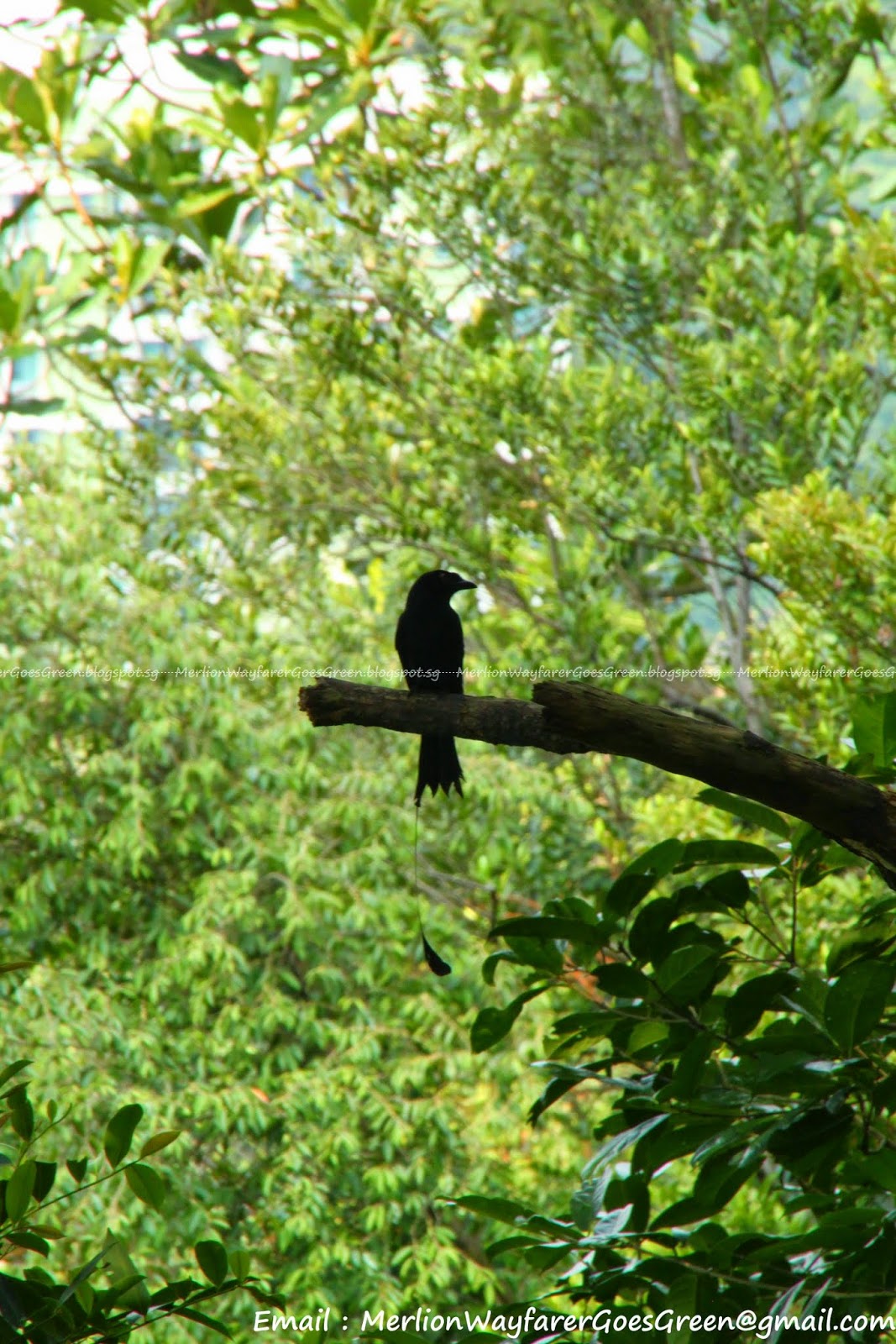
The Nintendo-sounding male Dicrurus paradiseus 
(Greater Racket-Tailed Drongo), a male with its beautiful tail...

The serene quarry view with its azure-blue water...

Flora with an interesting base...

A Tetragnathidae (Big-Jawed Spider) with a messy leaf-strewn web...

A real Cyclosa Spider on its web - See the difference?

Summiting at 463.63m one degree north of the Equator...

A not-so-usual hideout for an Argiope (St Andrew's Cross Spider) - A leaf instead of its web...

A fast-moving Salticidae (Jumping Spider) wanders about the railings...


More photos are available on :


Bukit Timah Nature Reserve - A Biodiverse Spider Habitat

Bukit Timah Nature Reserve
Central, Singapore
January 2014

Bukit Timah is located near the centre of the Singapore main island. Best known for its hill which stands at an altitude of 163.63 metres. it is the highest point in the city-state of Singapore.

A huge variety of trees and plants ensure abundance in biodiversity...

Bukit Timah Nature Reserve contains pockets of hill dipterocarp forest, not found anywhere else in Singapore. For a reserve of only 0.2% of Singapore's total area or 163 hectares, it is amazingly rich in biodiversity with about 40% of the nation's flora and fauna.

Nephila inaurata (Red-Legged Golden Orb-Web Spider) 
- a huge female many times bigger than your regular orb-webber...

Cyclosa bifida (Long-Bellied Cyclosa Spider) - See its tortoise-shell like carapace?


It slowly spins the victimized fly around...

Other orb-weavers laying in wait, including 
an Argiope Versicolor (Multi-Coloured St Andrew's Cross Spider) Male...

A gold-hued web without an owner...

Another Cyclosa bifida (Long-Bellied Cyclosa Spider) - 
One of the most photogenic orb spiders on a web...


Several Cyclosa Spiders at work...

 A restful Tanaecia pelea (Malay Viscount) Butterfly on the cemented path...

Gasteracantha hasseltii (Hasselt's Spiny Spider) - 
The spider with enough nasty-looking "thorns" to discourage would-be predators...