The Flying Saucer At Sunset

Lenticular clouds (Altocumulus lenticularis) are stationary lens-shaped clouds with a smooth layered appearance that form in the troposphere, usually above mountain ranges. One was spotted in Singapore recently...

Eyes Of 30,000 Honeycombs

With 30,000 individual facets, dragonflies have the most number of facets among insects. Each facet, or ommatidia, creates its own image, and the dragonfly brain has eight pairs of descending visual neurons to compile those thousands of images into one picture...

A Kaleidoscope Of Colours, Shapes And Patterns

Spectacular and innovative in design, the Flower Dome replicates the cool-dry climate of Mediterranean regions like South Africa, California and parts of Spain and Italy. Home to a collection of plants from deserts all over the world, it showcases the adaptations of plants to arid environments...

Lightning Strikes, Not Once, But Many Times

Unlike light, lightning does not travel in a straight line. Instead, it has many branches. These other branches flashed at the same time as the main strike. The branches are actually the step leaders that were connected to the leader that made it to its target...

Are You My Dinner Tonight?

A T-Rex has 24-26 teeth on its upper jaw and 24 more on its lower jaw. Juveniles have small, sharp blade-shaped teeth to cut flesh, whereas adults have huge, blunt, rounded teeth for crushing bones. Is the T-Rex a bone-crushing scavenger?

Art Seen & Herd! - Up Close & Personal

Night Safari
North, Singapore
05 June 2013

On World Environment Day 2013, Night Safari’s Art Seen & Herd! Exhibition was officially unveiled to the public as four of Singapore’s street artists unleashed wild artworks inspired by threatened animals to spread awareness about poaching and the dwindling wildlife population. 

Prem and her binturong were there to welcome Merlion Wayfarer and her friends...

A handler with his owl at the entrance...

After the launch of the exhibition, Merlion Wayfarer hopped on to the tram which journeys around the Night Safari through seven geographical regions to view over 2,500 nocturnal animals, including the threatened species featured in the exhibition. 


Chawang, the majestic bull elephant...
The Asian Elephant is one of the endangered species featured in Art Seen & Herd! 

She then attended the popular Creatures of the Night Show to see the nocturnal animals in action, and see how they help inculcate the conservation and recycling mindsets for the audience, especially the young kids.
(Excellent effort, WRS!)

The opening call by a wolf... Just like Twilight!

Spreading the conservation message through laughter, anticipation, and fun...

And finally, she took on the new Wallaby Trail to venture into the forest and limestone caves for even closer encounters with endangered wildlife...


The full albums are available at:

Art Seen & Herd! - The Artists & Their Works

Night Safari
North, Singapore
05 June 2013

On World Environment Day 2013, Night Safari’s Art Seen & Herd! Exhibition was officially unveiled to the public as four of Singapore’s street artists unleashed wild artworks inspired by threatened animals to spread awareness about poaching and the dwindling wildlife population. 

Shaiful introducing the four artists...

Isabel Cheng, Chief Marketing Officer, Wildlife Reserves Singapore, shares about Art Seen & Herd! Project...


SAVE THE GAME by Eman Jeman ("ClogTwo")
  

Like a game, the fate of the Indian rhino results in a win or loss. Long regarded as a symbol of strength, the rhino horn is ironically the bane of the animal. Rhinos are hunted for their horns to be used in traditional medicine. In actual fact, the rhino’s horn is made up of keratin, the exact same substance that our hair and nails are made of, and have no proven medical use. 


So why not say NO to using animal parts? Save the game, save the rhinos. 


PLIGHT NO MORE by Michael Ng ("Mindflyer")

 
A whimsical artwork with a message of hope and courage. A group of tiny spacemen are busy at work, trying to free a helpless Asiatic black bear from a bear bile farm by cutting off the chains and attaching wings to help it fly away to safety.


Imagine being trapped and housed in a tiny, restrictive "crush cage", tortured by pain and insanity to get your bile juice extracted daily from a thick needle inserted into your abdomen, all in the name of "traditional medicine". This bile-drawing process is painful, stressful and cruel. Will you be able to bear with this? 


Say NO to using animal parts and help keep their lives bearable. 


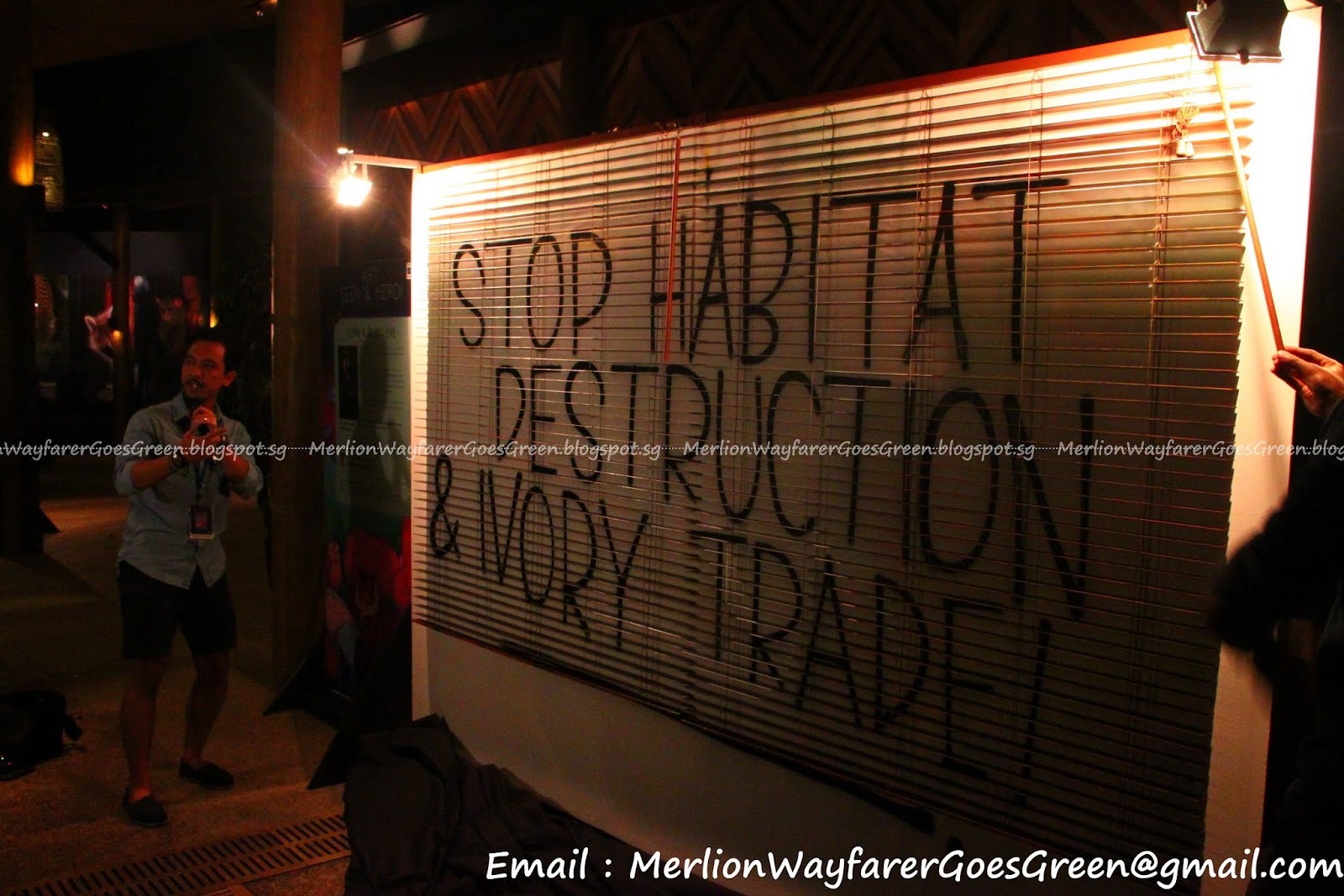
TURN A BLIND EYE by Luthi Mustafah ("The Killer Gerbil")


With the endless hunt for their ivory tusks and loss of natural habitats through deforestation, Asian elephants are rapidly depleting in numbers. 


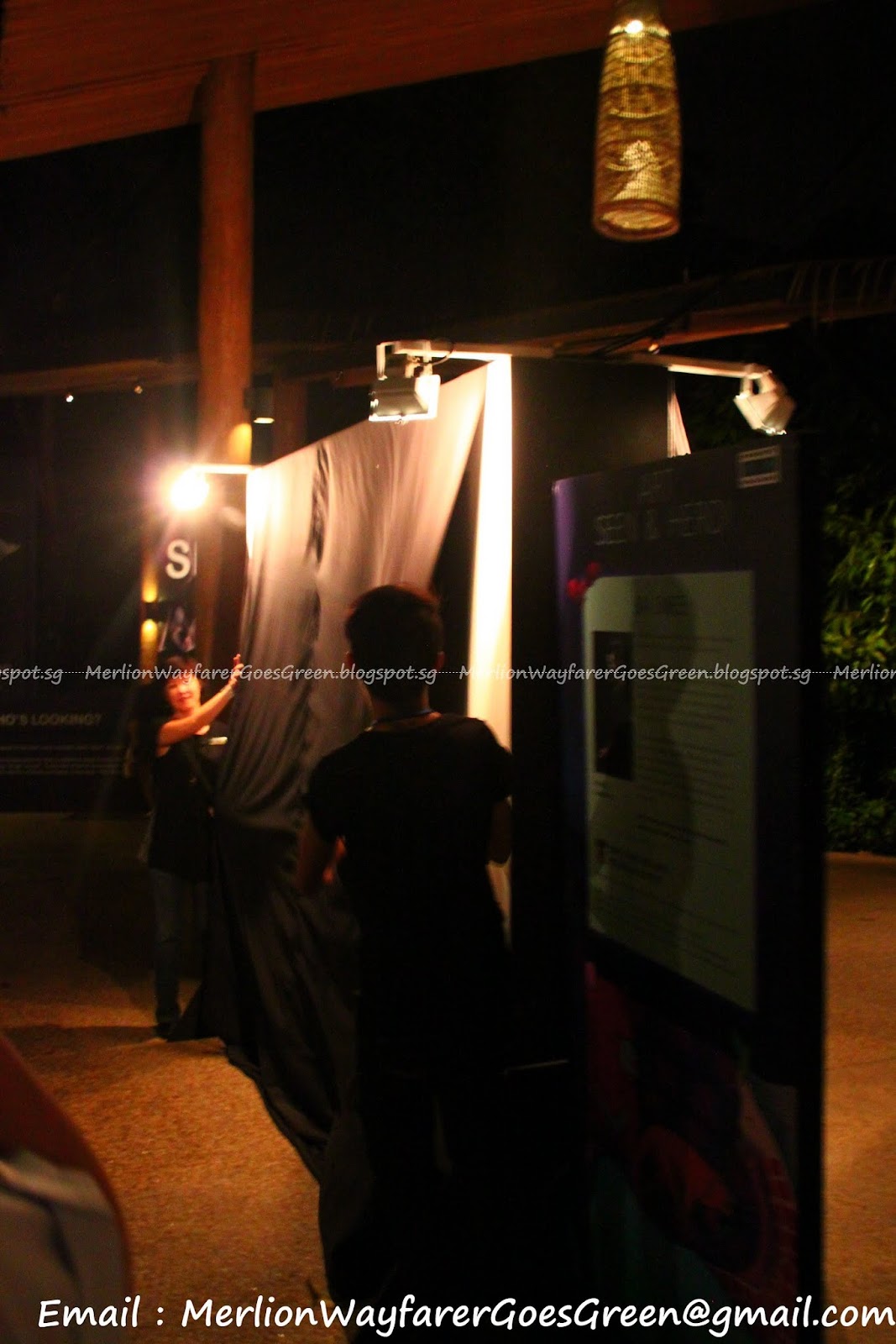
In this interactive artwork, wooden blinds form the canvas representing the once sprawling woods the elephants inhabit. Turning the blind first reveals a cry for help for the elephants before ending with a solemn and dark ending for the elephant from the loss of its tusks and natural habitat. This is a grave reminder for us not to turn a blind eye to the dire state of the elephants. The ivory trade must stop and it must begin with us. 


Say NO to buying ivory products and give these gentle giants a chance to live. 


BAI SWEE by Samantha Lo ("SKL0")
   

"Bai Swee", in the Hokkien dialect, means "only for show or display purposes". Which leaves us to think, what is real anymore?


The once majestic Malayan tigers are now merely puppets of the human race. As their strength and dominance in this world wane, we can only see their former selves portrayed and kept alive by their human keepers. Here lies a grim reminder that we have to work harder to preserve what nature offers or soon we will only have soulless and empty shells of the Malayan tigers.

Many of these majestic felines have been hunted for their parts to be used in traditional medicine. Tiger parts, like any other animal parts, can be replaced by alternative formulas in traditional medicine. 


Say NO to using animal parts and help keep these beautiful creatures living in the years to come. 


Light-hearted moments to conclude the launch with artists, staff and participants
spray-painting the GO WILD! wall...


The full albums are available at:

Night Safari’s Art Seen & Herd! Exhibition

Night Safari
North, Singapore
05 June 2013

On World Environment Day 2013, Night Safari’s Art Seen & Herd! Exhibition was officially unveiled to the public as four of Singapore’s street artists unleashed wild artworks inspired by threatened animals to spread awareness about poaching and the dwindling wildlife population. 

The Art Seen & Herd! Project employs art as a platform to raise awareness of wildlife poaching - one of the greatest threats to some of the world's most loved species. Animals featured in the exhibition include the Asian elephant, Malayan tiger, Indian rhino, and the newest residents of Night Safari – three Asiatic black bears. These animals are often hunted and farmed to feed continuing consumer demand for animal parts for use in traditional medicine, despite the presence of synthetic substitutes or there being no real evidence of the efficacy of these treatments.

The four artists - Michael Ng ("Mindflyer"), Samantha Lo ("SKL0"), Luthfi Mustafah ("The Killer Gerbil") and Eman Jeman ("ClogTwo") - also shared the inspiration and ideas behind their works, as well as the conservation messages that they hope to convey to visitors. Animals featured in the exhibition are often hunted and farmed to feed continuing consumer demand for animal parts for use in traditional medicine, despite the presence of synthetic substitutes or there being no real evidence of the efficacy of these treatments.
   
  • SAVE THE GAME by Eman Jeman ("ClogTwo")

  • PLIGHT NO MORE by Michael Ng ("Mindflyer")

  • TURN A BLIND EYE by Luthi Mustafah ("The Killer Gerbil")

  • BAI SWEE by Samantha Lo ("SKL0")

This free exhibition from now till 15 July 2013 at Night Safari’s entrance plaza.


Promotion For Students

 
To encourage students to learn more about the threats facing wildlife, Night Safari is offering a 50% discount on admission after 9pm from 1 June to 31 August 2013. The Art Seen & Herd! project also encourages students to take action by sharing information on the threats facing the animals and what they can do to save these species via popular social media platforms such as Instagram. More information on the contest and student discounts is available at  www.nightsafari.com.sg

Thank you for the opportunity to participate in this event and spread the conservation message, WRS!


The full albums are available at:

Sources

  • "NIGHT SAFARI PRESENTS: ART SEEN & HERD!" (23 May 2013). Media Release, Wildlife Reserves Singapore.
  • "NIGHT SAFARI UNVEILS ART SEEN AND HERD! EXHIBITION ON WORLD ENVIRONMENT DAY" (06 June 2013). Media Release, Wildlife Reserves Singapore.

Wishing Upon A Star

North-East, Singapore
May 2013

During last month's full moon low tides, Merlion Wayfarer was at the shores...

Beneath small stones, fragile Ophiuroidea (Brittle Star) starfishes roam...

Dull-coloured Actiniaria (Anemones) lay well-hidden...

A Paguroidea (Hermit Crab) with hairy legs in a borrowed shell under a stone peeking out...

Sometimes hiding sentry Cryptocentrus Leptocephalus (Slender-Lined Shrimp-Gobies) 
which watch over the burrows of the Alpheidae (Snapping Shrimps)...
(Read their story on "Nature's Sonic Boooom")

An Oxudercinae (Mudskipper) lies motionless, undisturbed by the actions of the gigantic human watching it...

[Video] These surfaces of several stones were covered by a living organism 
which breathes out little bubbles into the shallow water pools...


More photos are available on:


One Dollar, Two Dollars

Bidadari
North-East, Singapore
June 2013

It has been quite some time since Merlion Wayfarer stepped into a cemetery. Well, an exhumed one, to be exact. Today, she ventured into Bidadari with a nature pal. (Bidadari is best explored with a kaki, to be on the safe side.)
  

One of the safe paths to walk. If you stick to these paths, you need not step into the long grass areas. The grass here can be as long as thigh height, and there are lots of active ants here, so do wear long pants with longer socks.
  

A Hippasa Holmerae (Lawn Wolf Spider) with morning dew drops on its web. It builds the familiar sheet-webs that sparkle with dew drops over grassy grounds at dawn. The spider hides in a silken funnel that leads to the web and pounces on any grasshopper that lands on it.
   
  
The Blue Pansy (Junonia Orithya Wallacei) is a sun-loving butterfly, which can usually be found on grassy patches in open areas. This one here is having a hard time, as can be seen from its tattered wings.
  

A brilliant gold Orthetrum Luzonicum (Slender Blue Skimmer) rests on a blade of dried grass. At certain angles, the bronze on its wings shimmers in the bright morning sunlight.


The Mycalesis Mineus Macromalayana (Dark Brand Bush Brown) is one of the most common species of the many look-alike species of the genus Mycalesis. It is a drab-looking butterfly, with a dark-greyish brown upperside and a paler underside which features a white post-discal stripe on the fore and hindwings.
   

The Eurystomus Orientalis (Oriental Dollarbird) is named because of the distinctive blue coin-shaped spots on its wings. It is most commonly seen as a single bird with a distinctive upright silhouette on a bare branch high in a tree, from which it hawks for insects, returning to the same perch after a few seconds.
   

It has a distinctive call - a continuous guttural chirr, 
and sometimes it hides in the ample shade provided by the trees here with a mate...


The full albums are available at:


Sources

  • "Dollarbird". Wikipedia. Retrieved from http://en.wikipedia.org/wiki/Dollarbird (10 June 2013).
     
  • "Junonia orithya wallacei". Butterfly Circle Checklist. Retrieved from http://www.butterflycircle.com/checklist%20V2/CI/index.php/start-page/startpage/showbutterfly/108 (10 June 2013, Expired as of 2014).
  •    
  • "Mycalesis mineus macromalayana". Butterfly Circle Checklist. Retrieved from http://www.butterflycircle.com/checklist%20V2/CI/index.php/start-page/startpage/showbutterfly/117 (10 June 2013, Expired as of 2014