The Flying Saucer At Sunset

Lenticular clouds (Altocumulus lenticularis) are stationary lens-shaped clouds with a smooth layered appearance that form in the troposphere, usually above mountain ranges. One was spotted in Singapore recently...

Eyes Of 30,000 Honeycombs

With 30,000 individual facets, dragonflies have the most number of facets among insects. Each facet, or ommatidia, creates its own image, and the dragonfly brain has eight pairs of descending visual neurons to compile those thousands of images into one picture...

A Kaleidoscope Of Colours, Shapes And Patterns

Spectacular and innovative in design, the Flower Dome replicates the cool-dry climate of Mediterranean regions like South Africa, California and parts of Spain and Italy. Home to a collection of plants from deserts all over the world, it showcases the adaptations of plants to arid environments...

Lightning Strikes, Not Once, But Many Times

Unlike light, lightning does not travel in a straight line. Instead, it has many branches. These other branches flashed at the same time as the main strike. The branches are actually the step leaders that were connected to the leader that made it to its target...

Are You My Dinner Tonight?

A T-Rex has 24-26 teeth on its upper jaw and 24 more on its lower jaw. Juveniles have small, sharp blade-shaped teeth to cut flesh, whereas adults have huge, blunt, rounded teeth for crushing bones. Is the T-Rex a bone-crushing scavenger?

Bishan Park - The Drain Birds Of Singapore

As Singapore urbanizes, there are fewer and fewer grass patches and water sources for birds to obtain their much needed food. Surprisingly, the drains in Singapore can be a good place for spotting birds. In the revamped Bishan Park, a variety of shorebirds can be seen.


Little Egret (Egretta garzetta) 

The Little Egret (Egretta garzetta) is a species of small heron in the family Ardeidae. It is a white bird with a slender black beak, long black legs and, in the western race, yellow feet. As an aquatic bird, it feeds in shallow water and on land, consuming a variety of small creatures. It breeds colonially, often with other species of water birds, making a platform nest of sticks in a tree, bush or reed bed. Its main difference with its bigger cousins will be in its yellow-stockinged feet.


Sandpipers (Scolopacidae)

Sandpipers have long bodies and legs, and narrow wings. The bills are sensitive, allowing the birds to feel the mud and sand as they probe for food. They generally have dull plumage, with cryptic brown, grey, or streaked patterns.


White-Breasted Waterhen (Amaurornis phoenicurus)

Waterhens are dark slaty birds with a clean white face, breast and belly. They are somewhat bolder than most other rails and are often seen stepping slowly with their tail cocked upright in open marshes or even drains near busy roads. 

Here a mother brings her fledglings out for a walk in the evening...

One gets frightened of the rising water level and refuses to leave a rock, 
flapping its wings in distress until the adult came by to retrieve it...

Little Heron (Butorides striatus)

Little Herons eat mainly small fish and crustacea (especially crabs). They also take amphibians and insects and any other edible titbits, including small mammals.


Often, they perch-and-wait on a branch or root over the water, tucking in their necks and crouching in a low forward position over the water. They may flick their crests up and down as they wait. Little Herons may also jump, plunge or swim after their prey. Or they may use their feet to stir up or rake the surface for titbits. They may even dive into the water. But more impressively, they may bait fish and other prey, e.g., by dropping a leaf onto the surface.


Unfortunately, drains are also an area where
there is a accumulation of rubbish discarded from bigger drains...

Let's clean up our drains so that these birds will thrive...


Singapore Motorshow 2016

Suntec Singapore
January 2016
Following the success from the 2015 exhibit, the Singapore Motorshow returns for a second consecutive year from 14-17 January 2016 at Suntec City Convention & Exhibition Centre.

Making its debut at the Singapore Motorshow 2016 is the Subaru VIZIV 2
concept car, a next generation crossover vehicle, which similarly to its
predecessor, the VIZIV, takes its name from “Vision for Innovation”.
Colours abound at the various booths...
However, white seems to be the predominant colour...
 
It does help to have attractive models posing beside the cars, always ready with a smile...
Not to mention key attractions like game booths and MediaCorp personalities...

There were also photo opportunities with the friendly Russ Swift, who wowed the crowd with his stun driving skills...

Monsters Of The Sea - A Journey Into The Depths

Science Centre
Jurong East
January 2016

In days of yore, when dinosaurs ruled the Earth, sea monsters thronged the deep blue seas. With a single themed exhibition, Science Centre Singapore brings the world of massive marine beings to life with 14 prehistoric marine monsters side by side with their present-day sea counterparts with informative displays and interesting stories on mythical sea creatures.


“Monsters of the Sea will heighten interest among our visitors to discover more about these mighty marine animals - their ways of life, survival and possible causes of extinction. Perhaps this would initiate some to embark on a journey of revolutionary research on environmental change or conservation in future.”
- Associate Professor Lim Tit Meng, Chief Executive, SCS –


Pliosaurus was a massive marine reptile with a short necks and a large head with formidable teeth. Built for speed, this sea monster had limbs that were paddle-shaped to help them move swiftly through the water...

Educational panels illustrate key learning point for adults and children alike -
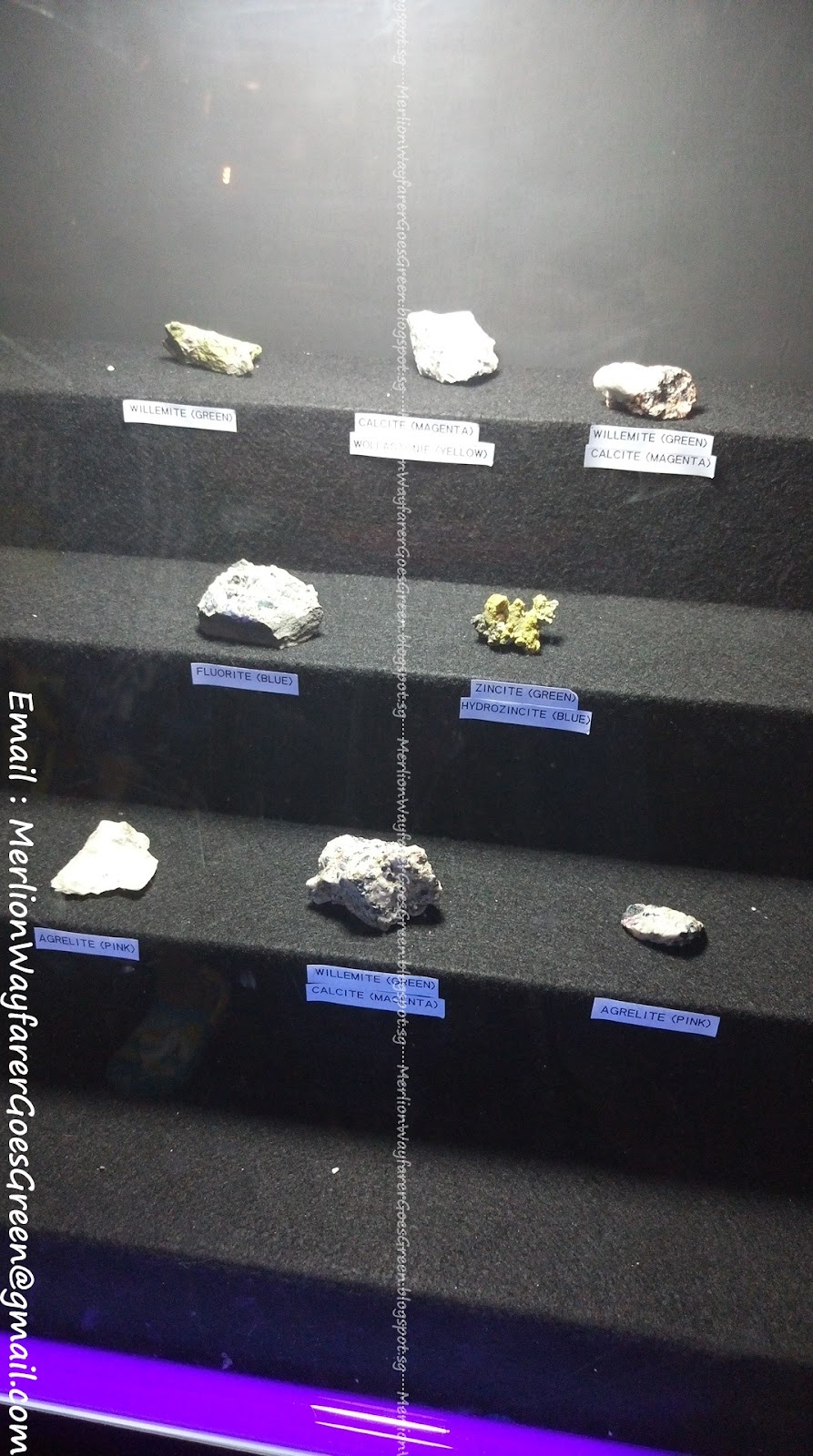
This panel here illustrates the difference between bioluminescence and biofluorescence,
and drives in the point further with glow-in-the-dark jellyfish and UV lights on pebbles...

Known to have the strongest jaw bite amongst four-footed animals, Purussaurus was an apex predator at the top of the food chain, and is capable of attacking very large vertebrates. with conical teeth curved backwards and slightly inwards...

A life-sized submersible with cardboard figures for photogenic poses...

Tylosaurus (or KnobLizard) was dubbed the “Predator of the late Cretaceous Seas”. It was ate sharks, flightless birds, large marine reptiles like Plesiosaurs, and other Mosasaurs...

For each letter of the alphabet, there is an accompany panel to list a monster from the depths...

A predator of the upper oceans, Mosasaurus tended to wait for other marine reptiles to surface for air, before using its tail to provide a quick burst of speed to launch its attack. Using its fearsome array of teeth, it ensures that any prey sliding down through its throat could not escape easily...

Young children can create their very own take-home monster in a jar or vibrating isopod at $5 each at this hands-on counter and learn about electron flow and buoyancy here...

Other fun stations to dig in the sand for fossils, fix a monster jigsaw,
or test your strength to generate enough "bite force"...

With a name meaning "Big Tooth", Megalodon lived during the Miocene period and had huge teeth that grew up to 18cm. These serrated and multiple rows of teeth allowed the sea monster to latch onto its prey tightly and rip it apart before swallowing...

Finally, be awed by the fascinating array of fossils from Singapore's very own Fossil Hunters...

The “Monsters of the Sea” exhibition will be held at the Science Centre Annexe Hall till 28 February 2016. For Singapore citizens and permanent residents, exhibition tickets are priced at $16 and $20 for children (3 to 12 years old) and adults respectively. Child and adult tickets are priced at $20 and $25 respectively for all other visitors. More information is available at www.science.edu.sg/exhibitions/Pages/MonstersoftheSea.aspx.