Triceratops Horridus - The Horrible Three-Horned Face
9:02 PM
Dinosaurs, Fascinating, Invites, Science Centre, West
"Titans of the Past - Dinosaurs & Ice Age Mammals"
Science Centre Singapore
Jurong East
West, Singapore
October/November 2013
Triceratops lived from 65-68 million years ago in the northern Rocky Mountain region of North America. Despite its huge size, it was a plant-eater.
It was one of the largest horned dinosaurs, with a skull 9 feet long and 6 feet wide - This meant that the width of a Triceratops head is as wide as that of a grown man lying down!
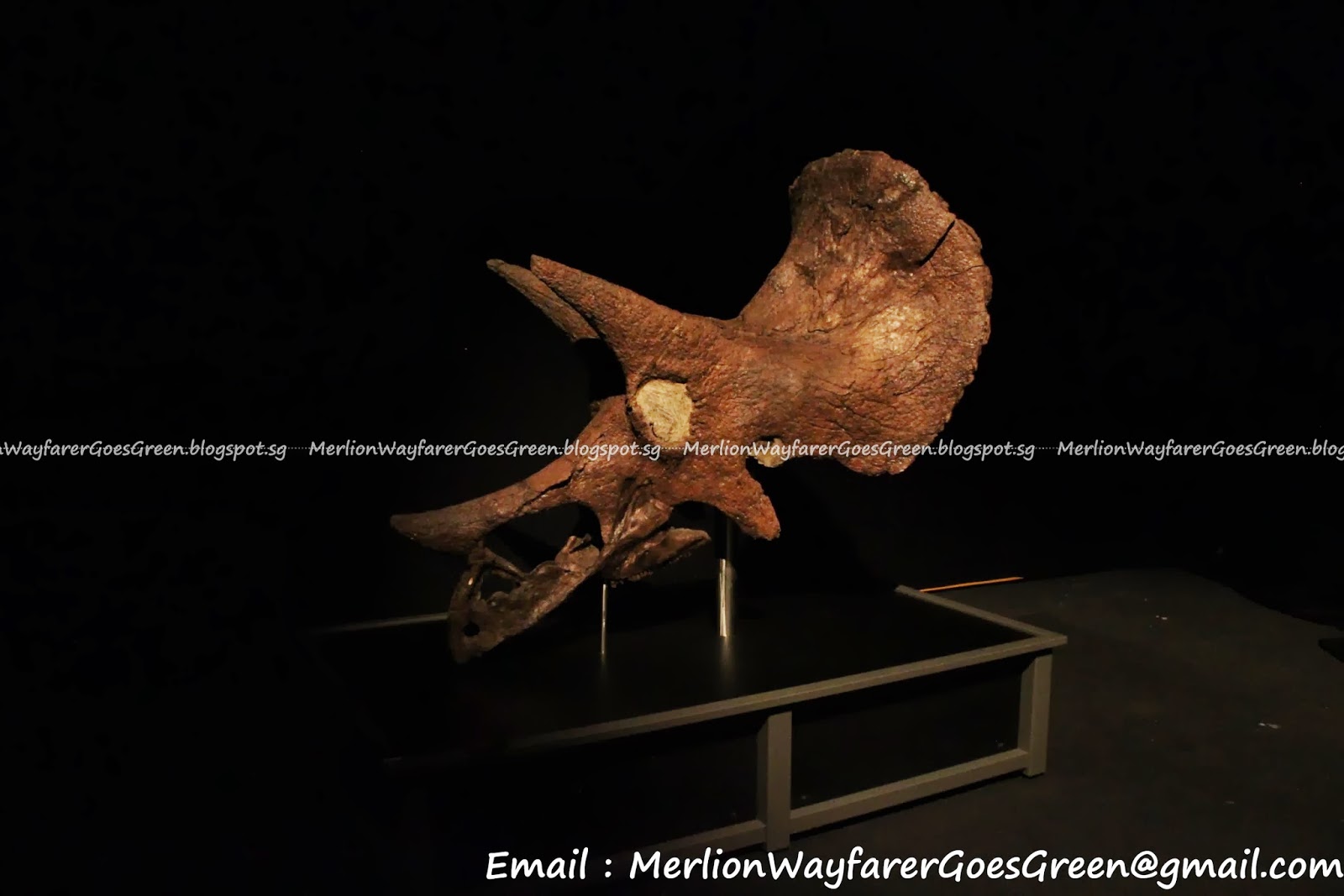
The live animal weighed about 20 thousand pounds. Comparatively, a large bull elephant weights only about 14,000 pounds.
The neck shields of Triceratops, and all other horned dinosaurs, were indented with branching blood-vessel channels. Its head was encompassed with keratin.
In today's context, birds with keratin beaks are often very colourful.
Compared to the smaller and younger Triceratops skulls, the bones in these skull are tightly-fused together with the orbital horns pointing completely forward.
Young Triceratops have a short frill while a fully mature Triceratops adult has a long frill and a long face.
As Triceratops age, their faces grow longer in proportion to their shields.
Juveniles have shorter nasal horns that have not been fully fused into the nasal bones.
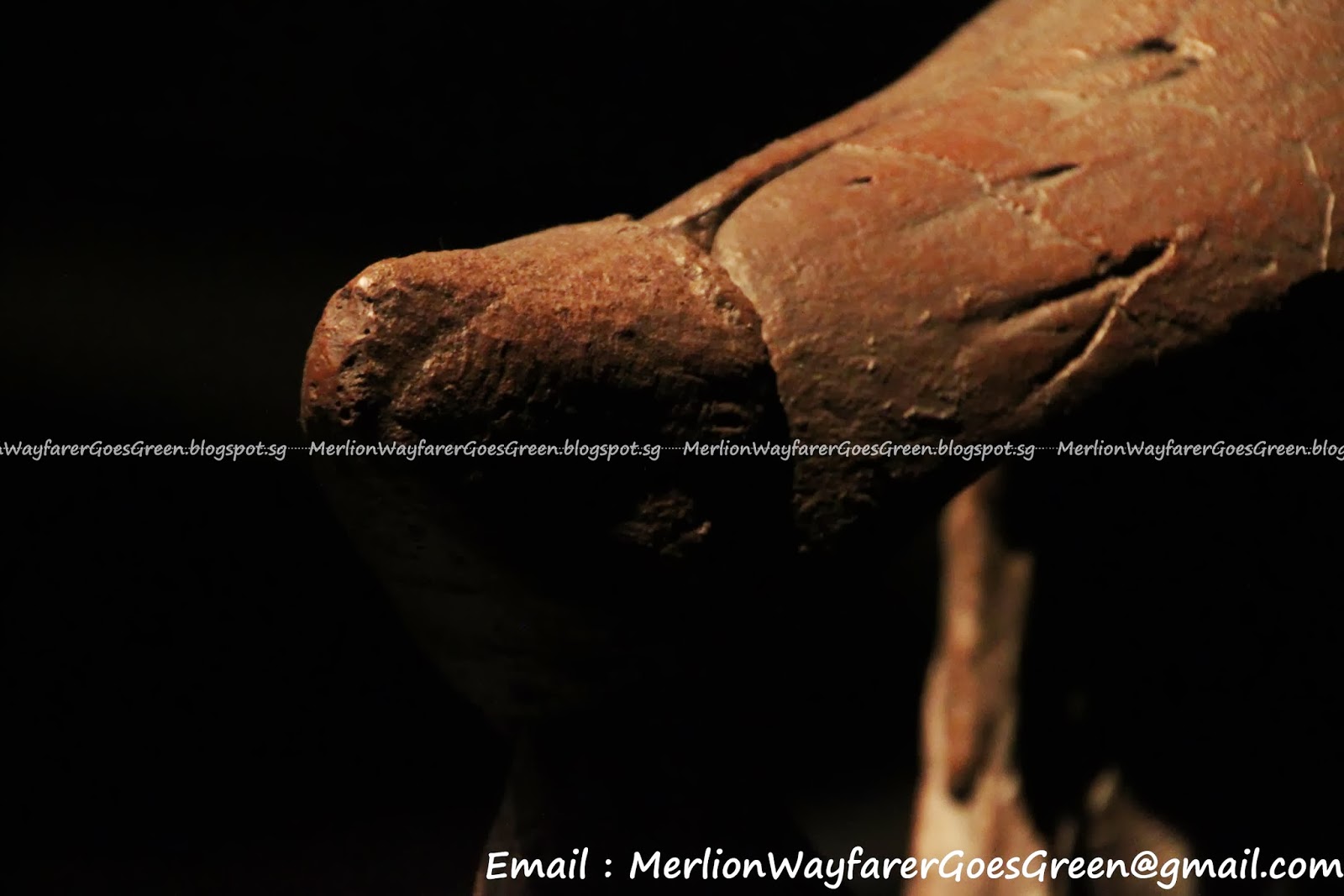
Blood vessel grooves are more prominent in adults. These grooves indicate that the keratin has hardened, and was pushing the vessels into the bone as the skull continued to grow.
"For more than 100 years, it was thought that Triceratops and Torosaurus were two different dinosaurs, but research at the Museum of the Rockies showed that Torosaurus was simply a full grown adult Triceratops."
JB Scannella & JR Horner (2010)
Dinosaur Cranial Ontogeny - Ah Boy Is Different From Papa
12:33 PM
Dinosaurs, Fascinating, Invites, Science Centre, West
"Titans of the Past - Dinosaurs & Ice Age Mammals"
Science Centre Singapore
Jurong East
West, Singapore
October/November 2013
The skulls of all dinosaurs changed shape as the animals grew older. These differences could be so that other individuals of the same species could recognize juveniles from adults.
Neoteny
The retention of juvenile characteristics with age
|
Neotenous animals are often considered "cute" because of their round heads, big eyes and shortened snouts. These young animals retain neoteny so that their parents will continue to care for them.
Modifications in skull shape might be due to changed diets as these neotenous animals grow up.
The Three Most Important Scientific Theories In Paleontology
Species that have once lived are now extinct
New species arise through a process of descent with modification via natural selection
|
Why does Ah Boy look so different from Papa?
Dinosaurs were known to be very social creatures, nesting in colonies and travelling in herds. Among such a big group of animals, it is important for adults to recognize their young to take care of them, and also when the young reach sexual maturity.
Broken Clouds
2:37 PM
Clouds, Natural Phenomena, Weather
City Hall MRT Station
Central, Singapore
September 2013
Merlion Wayfarer spotted this display at the City Hall MRT Station. She was stumped - How can clouds (which are soft and fluffy) be "broken"?
She Googled for an answer.
According to the General Weather Glossary at Louisville National Weather Service, "broken clouds" refer to "clouds which cover between 6/10 and 9/10 of the sky". This also means that unlike a typical cloudy day, you get to see the sun peeking out sometimes.
Ok, new term learnt...
Central, Singapore
September 2013
Merlion Wayfarer spotted this display at the City Hall MRT Station. She was stumped - How can clouds (which are soft and fluffy) be "broken"?
She Googled for an answer.
According to the General Weather Glossary at Louisville National Weather Service, "broken clouds" refer to "clouds which cover between 6/10 and 9/10 of the sky". This also means that unlike a typical cloudy day, you get to see the sun peeking out sometimes.
Ok, new term learnt...
Inaugural Native Birds’ Day At Jurong Bird Park
Jurong Bird Park
West, Singapore
November 2013
In a tribute to native birds, Jurong Bird Park, Asia’s largest bird sanctuary, will celebrate the inaugural Native Birds’ Day on 23 and 24 November.
The event aims to raise awareness on the importance of native birds and how the public can help protect them through a host of engaging activities including an expert forum, a bird photography trail, a photography exhibition and activities for children designed to educate young minds on the importance of conservation, in a fun and engaging manner.
As a special offer to native bird lovers, a 50% discount off Jurong Bird Park’s adult admission tickets will be offered to members of the public who sign up for the expert forum on 23 November.
The forum and activities are free; normal admission rates of $20 (adult) and $13 (child 3 to 12 years) apply for entry into Jurong Bird Park. More information can be found at www.wrs.com.sg
Merlion Wayfarer is looking forward to learning more about local feathered friends at the Native Birds’ Day on 23-24 November 2013 at Jurong Bird Park...
Titans of the Past - The Growth and Behaviour of Dinosaurs
11:08 PM
Dinosaurs, Fascinating, Invites, Science Centre, West
"Titans of the Past - Dinosaurs & Ice Age Mammals"
Science Centre Singapore
Jurong East
West, Singapore
October 2013
In the segment on "The Growth and Behaviour of Dinosaurs", the tracking of the development and growth of Triceratops, Pachycephalosaurus, Hypacrosaurus and T-Rex and the quality specimens found test the hypothesis of world-renowned palaeontologist Jack Horner and his research team who discovered that more than one-third of all dinosaur species classified from the Cretaceous Period may actually be juveniles and not different species as determined by palaeontologists for the past century. This exhibition is also the first attempt in the world to explore the concept of ontogeny - the development of an animal through its life and its implications for the science of palaeontology.
Science Centre Singapore
Jurong East
West, Singapore
October 2013
In the segment on "The Growth and Behaviour of Dinosaurs", the tracking of the development and growth of Triceratops, Pachycephalosaurus, Hypacrosaurus and T-Rex and the quality specimens found test the hypothesis of world-renowned palaeontologist Jack Horner and his research team who discovered that more than one-third of all dinosaur species classified from the Cretaceous Period may actually be juveniles and not different species as determined by palaeontologists for the past century. This exhibition is also the first attempt in the world to explore the concept of ontogeny - the development of an animal through its life and its implications for the science of palaeontology.
Juvenile and mature "dragons" from the past -
the Pachycephalosaurus with its distinctive skull dome...
Hypacrosaurus Stebingeri was a crested duck-billed dinosaur. These dinosaurs from the late Cretaceous Period cared for their young until they were old enough to leave the nest...
“The exhibition tells the story of a dinosaur’s life using real fossils and specimens that have played a pivotal role to facilitate our continuous efforts to demystify the prehistoric age and uncover new findings."
~ Dr Jack Horner, the MOR’s Curator of Palaeontology
and technical advisor for the Jurassic Park movies ~
Argentinosaurus, the largest Sauropod ever found measuring 36 metres in length and 7 metres in height...


Giganotosaurus is one of the largest terrestrial carnivores in the late Cretaceous period.
This skeleton here is 12m in length and 4m in height...
Subscribe to:
Posts (Atom)


