The Flying Saucer At Sunset

Lenticular clouds (Altocumulus lenticularis) are stationary lens-shaped clouds with a smooth layered appearance that form in the troposphere, usually above mountain ranges. One was spotted in Singapore recently...

Eyes Of 30,000 Honeycombs

With 30,000 individual facets, dragonflies have the most number of facets among insects. Each facet, or ommatidia, creates its own image, and the dragonfly brain has eight pairs of descending visual neurons to compile those thousands of images into one picture...

A Kaleidoscope Of Colours, Shapes And Patterns

Spectacular and innovative in design, the Flower Dome replicates the cool-dry climate of Mediterranean regions like South Africa, California and parts of Spain and Italy. Home to a collection of plants from deserts all over the world, it showcases the adaptations of plants to arid environments...

Lightning Strikes, Not Once, But Many Times

Unlike light, lightning does not travel in a straight line. Instead, it has many branches. These other branches flashed at the same time as the main strike. The branches are actually the step leaders that were connected to the leader that made it to its target...

Are You My Dinner Tonight?

A T-Rex has 24-26 teeth on its upper jaw and 24 more on its lower jaw. Juveniles have small, sharp blade-shaped teeth to cut flesh, whereas adults have huge, blunt, rounded teeth for crushing bones. Is the T-Rex a bone-crushing scavenger?

Jurong Bird Park - Southeast Asian Birds Aviary

Jurong Bird Park
Jurong Hill
West, Singapore
23 November 2013

Home to the region’s most exotic and endangered birds, the Southeast Asian Birds Aviary is located a short walk away from Pools Amphitheatre. The colourful free-flying birds are kept in a tropical rainforest landscape.

Mars & Venus

 Couples having a little bonding time...
  
The males love to strut around to display their splendour...


 A father stands guard at the nest while the mother is inside spending quality time with the babies...

Free Play

Other than the few endangered species, the other birds are free to fly and walk around in the open aviary...


The normally chatty Hill Mynah is rather shy today...
 
A peacock-wannabe...

Opportunities In Downpours

The rain's a perfect time to see birds all fluffed and streaked...

Don't let the air out!

Where's my comb?

 
This one was just blown-dry with a hair dryer...

In All Colours Of The Rainbow


It's time for a little food - Birds need their breakfast too...

Lovers' Ducks

Just outisde the Southeast Asian Birds Aviary lies a Bridge of Harmony...

Beneath it, lovers stay by each other...


More photos are available on Merlion Wayfarer Goes Green's Picasa at :
Places - Bird Park


Uniquely Singapore Birds

Jurong Bird Park
Jurong Hill
West, Singapore
23 November 2013

In a tribute to native birds, Jurong Bird Park, Asia’s largest bird sanctuary, celebrated its inaugural Native Birds’ Day on 23 and 24 November 2013.


Through a host of interesting activities, the event raised awareness on the importance of protecting of "Uniquely Singapore" birds endemic to this island country.


Native Birds’ Forum

An expert forum, helmed by Wildlife Reserves Singapore, NParks, Nature Society Singapore (NSS) and a veteran photojournalist presented the status of native birds and the ongoing conservation efforts by importance of these beautiful birds in our ecosystem. Speakers enthusiastically shared their passion and stewardship protection for native birds through personal anecdotes.

Topics include the photography of birds in "Birds in Action", "Common Sunbirds of Singapore", "Birds of Sungei Buloh" and "Local & Regional Conservation Projects".


NSS has two apps for nature lovers - one on birds and one on butterflies. Both are downloadable for iPhones and iPads to help in the identification and tracking of these...

 Where the migratory birds are most easily spotted in Sungei Buloh...

 NParks tags birds found in SBWR and how you can help spot and track migratory birds...

More and more sunbirds are found to change their feeding patterns by visiting plants found in aerial gardens in HDB flats. Here's how you can find one in your corridor...

Photography Trail

Wildlife photographer David Tan brought shutterbugs on a photography trail around the Bird Park, sharing tips and stories along the way.

While waiting, this Stork-Billed Kingfisher decided to make its presence known with its loud calls atop the pirate ship at Penguin Coast...

Starting out... And all armed with DSLRs!

"No need to take the whole bird, just focus on one part," he said...

Photography Exhibition

Photographs of native birds were featured in a photography exhibition at Penguin Coast. Picture-perfect moments, such as a White-Bellied Sea Eagle in mid-flight and a Oriental Pied Hornbill feeding its chick, are encapsulated within these frames.


Education Awareness Booth

A plethora of entertaining and enriching activities available for children was available at the Education Awareness Booth. Colour a bird on a sheet of paper, or if you are game enough, your own face could be the canvas for our friendly face-painters. A few of our local bird specimens, such as a hornbill casque, will be on display as well.

Face and hand-painting with animal stripes and spots...

Almost-real specimens of stuffed birds of prey...

 "Do you know why owls can fly so silently?"

"It's because of these feathers," she explained and sifted her fingers through the feathers...

Show Segment

A special 15 minutes show segment was presented by Otto, the yellow-naped Amazon, who sang the entire line of “I left my heart in San Francisco”. Children were able to try mimicking the bird in a mini-mimicry contest with the winner walking home with a token. A short photography session with the bird was also conducted.


More photos are available on Merlion Wayfarer Goes Green's Picasa at :
Places - Bird Park


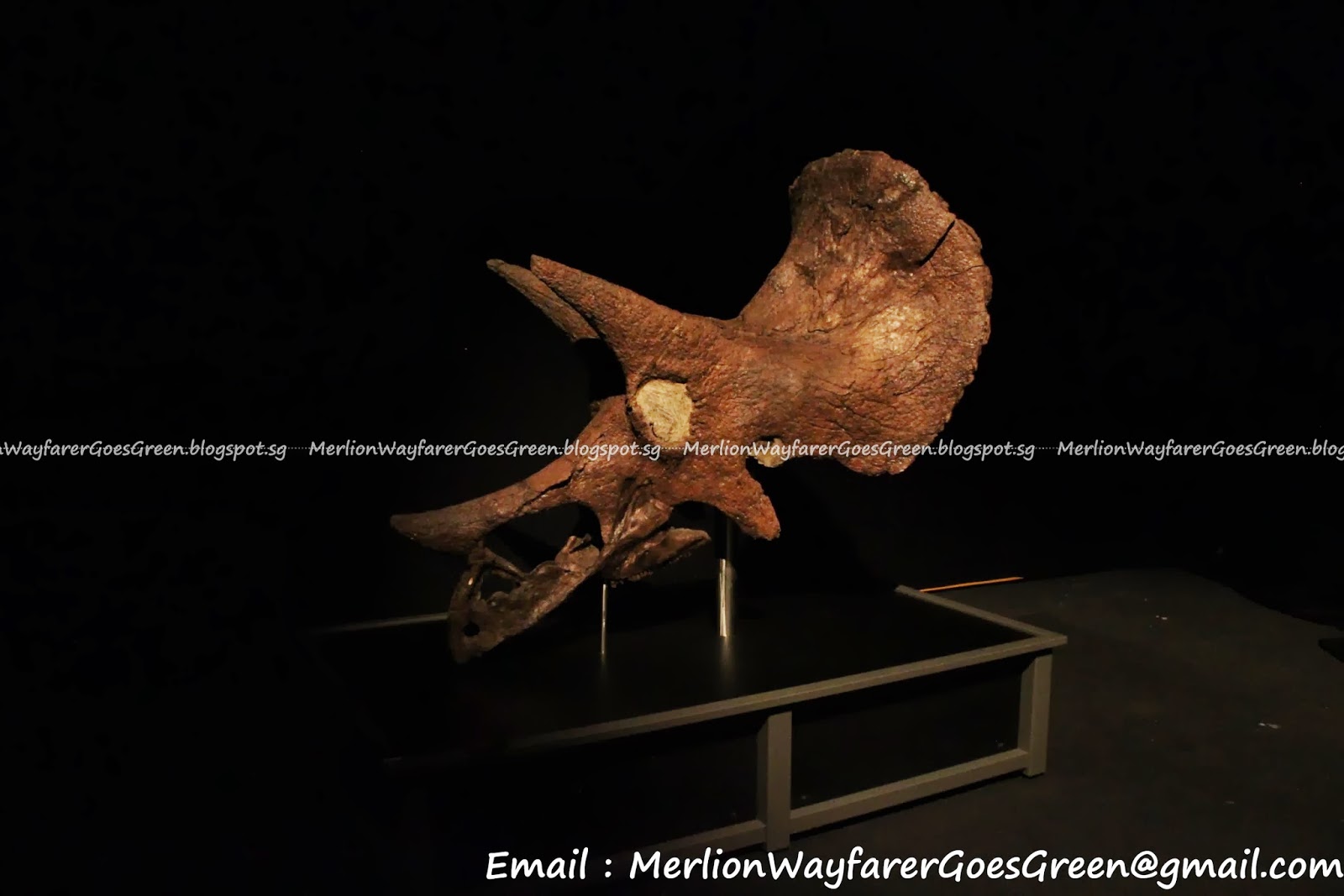
Triceratops Horridus - The Horrible Three-Horned Face

"Titans of the Past - Dinosaurs & Ice Age Mammals"
Science Centre Singapore
Jurong East
West, Singapore
October/November 2013

Triceratops lived from 65-68 million years ago in the northern Rocky Mountain region of North America. Despite its huge size, it was a plant-eater.


It was one of the largest horned dinosaurs, with a skull 9 feet long and 6 feet wide - This meant that the width of a Triceratops head is as wide as that of a grown man lying down!


The live animal weighed about 20 thousand pounds. Comparatively, a large bull elephant weights only about 14,000 pounds. 


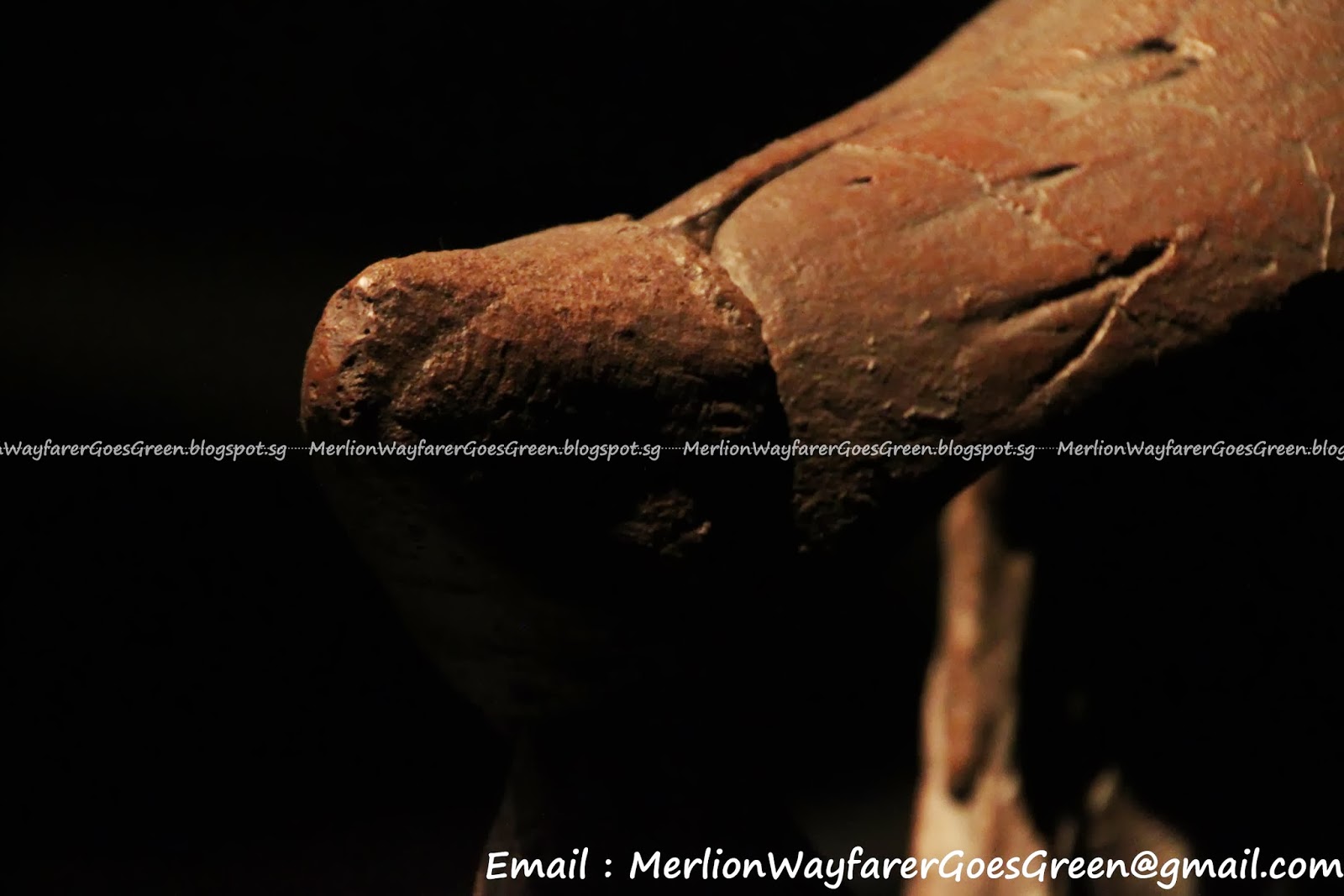
The neck shields of Triceratops, and all other horned dinosaurs, were indented with branching blood-vessel channels. Its head was encompassed with keratin.


In today's context, birds with keratin beaks are often very colourful.

Indications of Maturity

Compared to the smaller and younger Triceratops skulls, the bones in these skull are tightly-fused together with the orbital horns pointing completely forward.


Young Triceratops have a short frill while a fully mature Triceratops adult has a long frill and a long face. 


As Triceratops age, their faces grow longer in proportion to their shields.


Juveniles have shorter nasal horns that have not been fully fused into the nasal bones.


Blood vessel grooves are more prominent in adults. These grooves indicate that the keratin has hardened, and was pushing the vessels into the bone as the skull continued to grow.


"For more than 100 years, it was thought that Triceratops and Torosaurus were two different dinosaurs, but research at the Museum of the Rockies showed that Torosaurus was simply a full grown adult Triceratops."
JB Scannella & JR Horner (2010)


More photos are available on Merlion Wayfarer Goes Green's Picasa at :
Places - Science Centre


Dinosaur Cranial Ontogeny - Ah Boy Is Different From Papa

"Titans of the Past - Dinosaurs & Ice Age Mammals"
Science Centre Singapore
Jurong East
West, Singapore
October/November 2013

The skulls of all dinosaurs changed shape as the animals grew older. These differences could be so that other individuals of the same species could recognize juveniles from adults.


Neoteny
The retention of juvenile characteristics with age
Neotenous animals are often considered "cute" because of their round heads, big eyes and shortened snouts. These young animals retain neoteny so that their parents will continue to care for them.

Modifications in skull shape might be due to changed diets as these neotenous animals grow up.


The Three Most Important Scientific Theories In Paleontology
  1. Theory of Extinction
  2. Species that have once lived are now extinct
  3. Theory of Darwinian Evolution
  4. New species arise through a process of descent with modification via natural selection
  5. Theory of Radiometric Dating
    Elemental isotopes have predictable rates of decay and these rates can be used to determine the age of the rocks here the dinosaurs are found

Why does Ah Boy look so different from Papa?

Dinosaurs were known to be very social creatures, nesting in colonies and travelling in herds. Among such a big group of animals, it is important for adults to recognize their young to take care of them, and also when the young reach sexual maturity.


More photos are available on Merlion Wayfarer Goes Green's Picasa at :
Places - Science Centre


Broken Clouds

City Hall MRT Station
Central, Singapore
September 2013

Merlion Wayfarer spotted this display at the City Hall MRT Station. She was stumped - How can clouds (which are soft and fluffy) be "broken"?


She Googled for an answer.

According to the General Weather Glossary at Louisville National Weather Service, "broken clouds" refer to "clouds which cover between 6/10 and 9/10 of the sky". This also means that unlike a typical cloudy day, you get to see the sun peeking out sometimes.

Ok, new term learnt...


More photos are available on Merlion Wayfarer Goes Green's Picasa at :
Natural Phenomena - Clouds