The Flying Saucer At Sunset

Lenticular clouds (Altocumulus lenticularis) are stationary lens-shaped clouds with a smooth layered appearance that form in the troposphere, usually above mountain ranges. One was spotted in Singapore recently...

Eyes Of 30,000 Honeycombs

With 30,000 individual facets, dragonflies have the most number of facets among insects. Each facet, or ommatidia, creates its own image, and the dragonfly brain has eight pairs of descending visual neurons to compile those thousands of images into one picture...

A Kaleidoscope Of Colours, Shapes And Patterns

Spectacular and innovative in design, the Flower Dome replicates the cool-dry climate of Mediterranean regions like South Africa, California and parts of Spain and Italy. Home to a collection of plants from deserts all over the world, it showcases the adaptations of plants to arid environments...

Lightning Strikes, Not Once, But Many Times

Unlike light, lightning does not travel in a straight line. Instead, it has many branches. These other branches flashed at the same time as the main strike. The branches are actually the step leaders that were connected to the leader that made it to its target...

Are You My Dinner Tonight?

A T-Rex has 24-26 teeth on its upper jaw and 24 more on its lower jaw. Juveniles have small, sharp blade-shaped teeth to cut flesh, whereas adults have huge, blunt, rounded teeth for crushing bones. Is the T-Rex a bone-crushing scavenger?

Ants That Climb & Bind

Bukit Batok Nature Park
Central, Singapore
May 2013

Near a footpath at the Bukit Batok Nature Park where she met "The Laughing Zorro Bird", Merlion Wayfarer noticed a colony of Oecophylla Smaragdina (Weaver Ants) building a nest among some shrubs. These are the commonly-termed "red ants" that inhabit trees and bushes, move around a lot, and tend to crawl into your footwear and inflict painful bites.

(There are lots of ants here, so do make sure you are wearing long pants with proper shoes and socks when you explore this park.)

The weaver ant's ability to build capacious nests from living leaves has undeniably contributed to their ecological success. The initial phase in nest construction involves workers surveying potential nesting leaves by pulling on the edges with their mandibles. When a few ants have successfully bent a leaf onto itself or drawn its edge toward another, other workers join in the effort. The probability of a worker joining the concerted effort is dependent on the size of the group, with workers showing a higher probability of joining when the group size is large.


When the span between two leaves is beyond the reach of a single ant, workers form chains with their bodies by grasping one another's petiole (waist). Multiple intricate chains working in unison are often used to ratchet together large leaves during nest construction. Once the edges of the leaves are drawn together, other workers retrieve larvae from existing nests using their mandibles. These workers hold and manipulate the larvae in such a way that causes them to excrete silk. They can only produce so much silk, so the larva will have to pupate without a cocoon. The workers then maneuver between the leaves in a highly coordinated fashion to bind them together.


Weaver ants' nests are usually elliptical in shape and range in size from a single small leaf folded and bound onto itself to large nests consisting of many leaves and measure over half a meter in length. The time required to construct a nest varies depending on the leaf type and eventual size, but often a large nest can be built in significantly fewer than 24 hours. Although weaver ants' nests are strong and impermeable to water, new nests are continually being built by workers in large colonies to replace old dying nests and those damaged by storms.


The full albums are available at:

Sources

  • "Dynamics of aggregation and emergence of cooperation" by DENEUBOURG, J.L., Lioni, A. & DETRAIN, C. (2002).  Biological Bulletin 202:262-267.
  • "The ants" by HOLLDOBER, B. & WILSON, E.O. (1990). Harvard University Press, Cambridge, Massachusetts.

My Kiwis Are Planted By Handsome Italian Men!

Singapore
June 2013

This morning, Merlion Wayfarer drank a freshly-blended kiwi smoothie.

(Source : My Danish Kitchen)

Now, Italy is the world’s largest kiwi producer. The trans-alpine country has an extension of 25,000 hectares of kiwi, basically spread over the most typical areas: The Veneto (around Verona), Emilia-Romagna (around Cesena) and Latina (Southern Rome).

(Source : Lonely Planet)

This could mean that what she drank could be planted by someone as good-looking as these!

The handsome Italian-American crooner, the handsome Italian-American lover, the handsome Italian-American dancer....

Curious about the origins of her food, she took a walk in the supermarket. Here's what she found...

Carrots and apples from the lands of Crocodile Dundee and Lord of the Rings. 
And yes, I "envy" the fresh air and green fields these fruits enjoyed there...

Nearer to Singapore, yet still a plane ride away - Dragonfruit from Vietnam and mangoes from India...

These probably suffered from bum ache from at least 24 hours of plane journey - 
Pears and lemons from South Africa, black grapes from Chile, blueberries from Morocco...

From exotic lands filled with mystique that you often see in travel brochures - 
Apricots from Turkey and green grapes from Egypt...

Not to mention the famous Valencia oranges from the US...

Ok ok, we all know that growing organic food causes fewer greenhouse gases than traditional farming. But what happens when your organic kiwis shipped from Italy to Singapore?

Most produce is picked 4 to 7 days before being placed on supermarket shelves, and is shipped for an average of 1,500 miles before being sold. As your breakfast racks up "food miles", it is also accumulating a larger ecological footprint due to the energy required to store and transport around the globe.

As a result of its time in transit, your kiwis probably require a lot more packing to keep it in good shape. And it is plucked when still in the raw stage. That explains why so many kiwis taste sour if you try to eat them straight after you bought them from the supermarket.


Where available, consider choosing produce grown nearer to Singapore, e.g. Pasar range. They are grown locally or in regional countries like Malaysia and Thailand.

It is World Environment Day 2013 today, so THINK before you EAT and SAVE the environment.

Think.Eat.Save


The full album is available at:

Sources


Think Global, Eat Local

Singapore
June 2013

(Source : My Danish Kitchen)

After discovering that the kiwis in the smoothie she drank could be planted by handsome Italian men ("My Kiwis Are Planted By Handsome Italian Men!"), and thinking about the journey the poor kiwis took to be transported halfway around the world to Singapore, Merlion Wayfarer decided to compile a short-and-sweet list of why you should eat food produced locally (and regionally).
  1. Locally-grown food tastes and looks better. The crops are picked at their peak. Livestock products are processed in nearby facilities and typically the farmer has a direct relationship with the processors, overseeing quality - unlike animals processed in large industrial facilities.
      
  2. Local food is better for you. The shorter the time between the farm and your table, the less likely it is that nutrients will be lost from fresh food. Food imported from far away is older and has traveled further on trucks, ships or planes, and sat in warehouses longer before it gets to you.
      
  3. Local food preserves genetic diversity. In the modern agricultural system, plant varieties are chosen for their ability to ripen uniformly, withstand harvesting, survive packing, and last a long time on the shelves, so there is limited genetic diversity in large-scale production. Smaller local farms, in contrast, often grow many different varieties of crops to provide a long harvest season, an array of colours, and the best flavors. They also tend to produce crops according to the season and soil conditions, and use organic fertilizers. Large farms tend to milk the environment and overharvest to increase crop yield. Livestock diversity is also higher where there are many small farms rather than few large farms.
      
  4. Local food benefits the environment and wildlife. Well-managed farms provide ecosystem services: they conserve fertile soil, protect water sources, and sequester carbon from the atmosphere. The farm environment is a patchwork of fields, meadows, woods, ponds and buildings that provide habitat for wildlife within the communities.

Commercial vertical farming in Singapore which produces one tonne of produce every other day for local supermarkets...
(Source : Inhabitat)

Hydroponics & aeroponics farming in Singapore...
(Source : Blogspot & Geography ATT)

Sources


Don't Let That Branch Fall On Me! - Detecting Tree Failure

Singapore
June 2013

Tall trees in some parts of Singapore are being replaced more speedily with shorter, smaller species to reduce the risk of falling branches and trees toppling over. (Straits Times, 19 May 2013) There were 122 uprooted trees from January to April this year. This was a drop from 184 trees in the same period last year but more than double the 63 in 2009. (Asia One, 21 May 2013) 

The highest number was in 2011, when 636 trees were uprooted, mainly due to microbursts - a localised, powerful and descending air draft column, which produces winds at high speeds - that occurred in Mandai and Sungei Kadut that February. (Asia One, 21 May 2013) 

(Source : Straits Times)

The National Parks Board (NParks) has over the past two years stepped up its ongoing replacement planting programme taking into account shifts in weather patterns in the region. It said that incidents of "tree failure", defined as anything from broken branches to fallen trees, have been caused mainly by bouts of adverse weather conditions rather than maintenance issues. So it is replacing some familiar trees with species that might be less vulnerable to mishap, and also grouping different trees together in some areas, so they can withstand bad weather.

Trees reduce noise and air pollution. However, adverse weather conditions can result in damage to vehicles and property, and injury to passers-by.

NParks Tree Maintenance Programme

  
Trees under the National Parks Board's (NParks) charge are maintained in a healthy and stable condition. The frequency of tree inspections along major roads or areas with high human activity is at least once every 12 months. The inspection details are recorded and entered into a database for future reference. Where necessary, crown reduction pruning is carried out to reduce the weight of tree crowns so that they can better withstand strong winds.

Healthy trees can also be affected by strong winds and heavy rainfall, so it is not possible to totally eliminate risk of tree falls. Often, NParks' checks on fallen branches and trees showed that the incidences were mainly due to such adverse weather conditions, rather than poor health or tree rot.

Since 2003, NParks carries out regular exercises  to replace storm-vulnerable trees. It has also identified tree species that are more hardy, as well as those that are more storm-vulnerable. These are done together with frequent monitoring of the local weather patterns for changes in the severity of storms and intensity of rainfall.

Before removing storm-vulnerable trees, NParks plants suitable tree species in the vicinity to mitigate against the temporary loss of greenery.  Where possible, these new trees are planted before the removals.  In most cases, the number of trees planted is more than the number to be removed.  These new trees include native species that add to the biodiversity in our urban landscape.

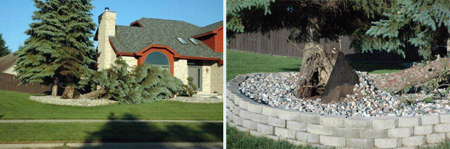
What Are Some Signs Of Tree Failure?

  • Termite trails
(Source : Veggie Revolution)
  
  • Constrained root growth or trees planted too deep
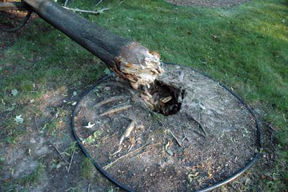
  • Gaping holes or cracks in trunks, especially at soil level
(Source : Hendron Tree Care)
 
  • Excessive fungi, vine, creeper or parasitic plant growth resulting in cavities and decay
(Source : Blue Jay Barrens)
 
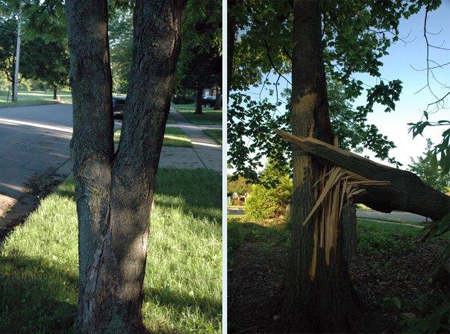
  • Splintering branches or V-shaped forks in trunks
  • Bark has mostly fallen off, exposing smooth wood underneath
(Source : Dukes Wood Project)
  
  • Trees or branches that are bleached, leafless or non-flowering unlike those around them
(Source : Crimson Canopy)
 
  • Reclining, knobbly or curved trunks
(Source : Hendron Tree Care)
  

And of course, a sharp ear to listen out for cracks when near any tree helps...
It helps if you speak softly when in nature reserves so that you don't scare away all the fauna before you come to them...  ;) 
(Source : Hendron Tree Care)
   

Are There Any Types Of Trees Which Are More Prone?

 
The Albizia tree is a fast-growing species which spread rapidly on vacant lands if left on its own. Under favourable conditions, Albizias can easily exceed 40m in height. Compared to other tree species, the wood tissues of Albizias are relatively soft, brittle and prone to breakage during storms. They are also known to suffer from pest and disease problems, such as root rot. Hence, Albizias are prone to uprooting, especially during storms.

Successful rehabilitation of a site with Albizia trees at Jalan Anak Bukit. Albizias were selectively removed,
while retaining most of the existing trees and vegetation...
(Source : NParks & SLA)

It is impossible to check every single tree in Garden City Singapore monthly. Even with a team of contractors. There are trees by the roads, trees in schools, trees near houses, trees in nature reserves, trees by boardwalks, trees in private compounds... Estimates place the number of trees planted from the tree planting campaign alone at 450,000 (45 years multiplied by a minimum of 10,000 trees each year).

Trees not only pose a danger through uprooting, 
dangers can also be caused by splintering trunks and falling branches.
(Source : Popular Mechanics)
 

Here are some tips for us drivers/trekkers/pedestrians:
  • If you are going to a wooded area or walking/parking beneath a tree, observe for signs of tree failure.
  • Do not go into a wooded area immediately after heavy rain and strong winds.
  • Report likely signs of tree failure to NParks at 1800-471-7300.

Sources


Lightning Strikes, Not Once, But Many Times

Singapore
June 2013

Merlion Wayfarer was awaken by the bouts of thunder this morning. They came frequently, at a low rumble through the night. Frustrated, she opened the curtains.

This is what she saw...

She was curious - Unlike light, lightning does not travel in a straight line. Instead, it has many branches...

These other branches flashed at the same time as the main strike. Next you notice that the main strike flickers or dims a few more times in a single split second. The branches are actually the step leaders that were connected to the leader that made it to its target.


When the first strike occurs, current flows to neutralize the charge separation. This requires that the current associated with the energy in the other step leaders also flows to the ground. The electrons in the other step leaders, being free to move, flow through the leader to the strike path. So when the strike occurs, the other step leaders are providing current and exhibiting the same heat flash characteristics of the actual strike path. After the original stroke occurs, it is usually followed by a series of secondary strikes. These strikes follow only the path of the main strike; the other step leaders do not participate in this discharge.


It is very possible that the main strike is followed by 30 to 40 secondary strikes. Depending on the time delay between the strikes, it may look like one long-duration main strike, or a main strike followed by other flashes along the path of the main strike. The secondary strike can occur while the flash from the main stroke is still visible. Obviously, this may seem that the main-stroke flash lasted longer than it actually did. Similarly, the secondary strikes may occur after the flash from the main strike ends, making it appear that the main strike is flickering.


More photos are available on Merlion Wayfarer Goes Green's Picasa at :
Natural Phenomena