


Singapore
June 2013

The National Parks Board (NParks) has over the past two years stepped up its ongoing replacement planting programme taking into account shifts in weather patterns in the region. It said that incidents of "tree failure", defined as anything from broken branches to fallen trees, have been caused mainly by bouts of adverse weather conditions rather than maintenance issues. So it is replacing some familiar trees with species that might be less vulnerable to mishap, and also grouping different trees together in some areas, so they can withstand bad weather.


June 2013
Tall trees in some parts of Singapore are being replaced more speedily with shorter, smaller species to reduce the risk of falling branches and trees toppling over. (Straits Times, 19 May 2013) There were 122 uprooted trees from January to April this year. This was a drop from 184 trees in the same period last year but more than double the 63 in 2009. (Asia One, 21 May 2013)
The highest number was in 2011, when 636 trees were uprooted, mainly due to microbursts - a localised, powerful and descending air draft column, which produces winds at high speeds - that occurred in Mandai and Sungei Kadut that February. (Asia One, 21 May 2013)

(Source : Straits Times)
The National Parks Board (NParks) has over the past two years stepped up its ongoing replacement planting programme taking into account shifts in weather patterns in the region. It said that incidents of "tree failure", defined as anything from broken branches to fallen trees, have been caused mainly by bouts of adverse weather conditions rather than maintenance issues. So it is replacing some familiar trees with species that might be less vulnerable to mishap, and also grouping different trees together in some areas, so they can withstand bad weather.
Trees reduce noise and air pollution. However, adverse weather conditions can result in damage to vehicles and property, and injury to passers-by.
NParks Tree Maintenance Programme
Trees under the National Parks Board's (NParks) charge are maintained in a healthy and stable condition. The frequency of tree inspections along major roads or areas with high human activity is at least once every 12 months. The inspection details are recorded and entered into a database for future reference. Where necessary, crown reduction pruning is carried out to reduce the weight of tree crowns so that they can better withstand strong winds.
Healthy trees can also be affected by strong winds and heavy rainfall, so it is not possible to totally eliminate risk of tree falls. Often, NParks' checks on fallen branches and trees showed that the incidences were mainly due to such adverse weather conditions, rather than poor health or tree rot.
Since 2003, NParks carries out regular exercises to replace storm-vulnerable trees. It has also identified tree species that are more hardy, as well as those that are more storm-vulnerable. These are done together with frequent monitoring of the local weather patterns for changes in the severity of storms and intensity of rainfall.
Before removing storm-vulnerable trees, NParks plants suitable tree species in the vicinity to mitigate against the temporary loss of greenery. Where possible, these new trees are planted before the removals. In most cases, the number of trees planted is more than the number to be removed. These new trees include native species that add to the biodiversity in our urban landscape.
What Are Some Signs Of Tree Failure?
- Termite trails

(Source : Veggie Revolution)
- Constrained root growth or trees planted too deep
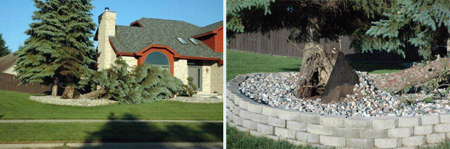
(Source : Michigan State University Extension)
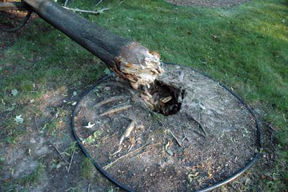
- Gaping holes or cracks in trunks, especially at soil level


(Source : Hendron Tree Care)
- Excessive fungi, vine, creeper or parasitic plant growth resulting in cavities and decay

(Source : Blue Jay Barrens)
- Splintering branches or V-shaped forks in trunks
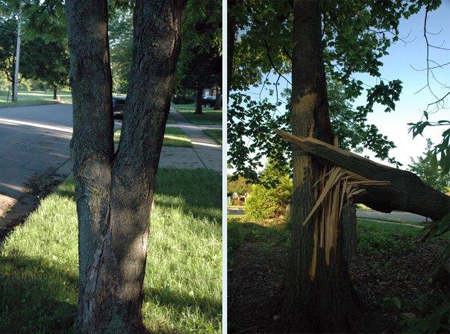

(Source : Michigan State University Extension & Hendron Tree Care)
- Bark has mostly fallen off, exposing smooth wood underneath

(Source : Dukes Wood Project)
- Trees or branches that are bleached, leafless or non-flowering unlike those around them

(Source : Crimson Canopy)
- Reclining, knobbly or curved trunks

And of course, a sharp ear to listen out for cracks when near any tree helps...
It helps if you speak softly when in nature reserves so that you don't scare away all the fauna before you come to them... ;)

It helps if you speak softly when in nature reserves so that you don't scare away all the fauna before you come to them... ;)
(Source : Hendron Tree Care)
Are There Any Types Of Trees Which Are More Prone?
The Albizia tree is a fast-growing species which spread rapidly on vacant lands if left on its own. Under favourable conditions, Albizias can easily exceed 40m in height. Compared to other tree species, the wood tissues of Albizias are relatively soft, brittle and prone to breakage during storms. They are also known to suffer from pest and disease problems, such as root rot. Hence, Albizias are prone to uprooting, especially during storms.


It is impossible to check every single tree in Garden City Singapore monthly. Even with a team of contractors. There are trees by the roads, trees in schools, trees near houses, trees in nature reserves, trees by boardwalks, trees in private compounds... Estimates place the number of trees planted from the tree planting campaign alone at 450,000 (45 years multiplied by a minimum of 10,000 trees each year).
Successful rehabilitation of a site with Albizia trees at Jalan Anak Bukit. Albizias were selectively removed,
while retaining most of the existing trees and vegetation...
while retaining most of the existing trees and vegetation...


(Source : NParks & SLA)
Trees not only pose a danger through uprooting,
dangers can also be caused by splintering trunks and falling branches.

(Source : Popular Mechanics)
Here are some tips for us drivers/trekkers/pedestrians:
- If you are going to a wooded area or walking/parking beneath a tree, observe for signs of tree failure.
- Do not go into a wooded area immediately after heavy rain and strong winds.
- Report likely signs of tree failure to NParks at 1800-471-7300.
Sources
- "Four killed, 62 injured by fallen trees over last 10 years: Khaw" (13 May 2013). Channel NewsAsia. Retrieved from http://news.xin.msn.com/en/singapore/four-killed-62-injured-by-fallen-trees-over-last-10-years-khaw (04 June 2013).
- "How Do You Know a Tree Limb Is About to Fall?" by Miriam KRAMER (17 May 2012). Popular Mechanics. Retrieved from http://www.popularmechanics.com/outdoors/survival/tips/how-do-you-know-a-tree-limb-is-about-to-fall-8922559 (04 June 2013).
- "How many trees are there in Singapore?" (22 June 2008). ASK!, National Library Board. Retrieved from http://blogs.nlb.gov.sg/ask/children/566 (02 June 2013)
- "How to Recognize and Prevent Tree Hazards" by Larry TANKERSLEY. Agricultural Extension Service, The University of Tennessee. Retrieved from http://www.nwcg.gov/branches/pre/rmc/htsc/toolbox_assessment/how_to_id_tree_hazards.pdf (03 June 2013, Expired as of 2014).
- "How To Recognize Dead Wood" by Jonathan LANDSMAN. Trees & Shrubs, Home, About.com. Retrieved from http://treesandshrubs.about.com/od/pruning/a/recognizing-dead-wood-in-trees-and-shrubs.htm (04 June 2013).
- "NParks' Tree Management programme" (01 January 2013). National Parks Board. Retrieved from http://www.nparks.gov.sg/cms/index.php?option=com_news&task=view&id=154&Itemid=50 (02 June 2013).
- "Riding the storm out: Observe tree failures and prevent them for the future" by Bert CREGG (25 June 2010). Departments of Horticulture and Forestry, Michigan State University Extension. Retrieved from http://msue.anr.msu.edu/news/riding_the_storm_out_observe_tree_failures_and_prevent_them_for_the_future (03 June 2013).
- "Some tall trees being replaced" by HOE Pei Shan (21 May 2013). Motoring News, ST Cars. Retrieved from http://www.stcars.sg/guides-articles/motoring-news/some-tall-trees-being-replaced/a/119691 (04 June 2013, Expired as of 2014).
- "Some tall trees being replaced to reduce risks" by HOE Pei Shan (19 May 2013). Straits Times Online. Retrieved from http://www.straitstimes.com/breaking-news/singapore/story/some-tall-trees-being-replaced-reduce-risks-20130519 (02 June 2013).


