The Flying Saucer At Sunset

Lenticular clouds (Altocumulus lenticularis) are stationary lens-shaped clouds with a smooth layered appearance that form in the troposphere, usually above mountain ranges. One was spotted in Singapore recently...

Eyes Of 30,000 Honeycombs

With 30,000 individual facets, dragonflies have the most number of facets among insects. Each facet, or ommatidia, creates its own image, and the dragonfly brain has eight pairs of descending visual neurons to compile those thousands of images into one picture...

A Kaleidoscope Of Colours, Shapes And Patterns

Spectacular and innovative in design, the Flower Dome replicates the cool-dry climate of Mediterranean regions like South Africa, California and parts of Spain and Italy. Home to a collection of plants from deserts all over the world, it showcases the adaptations of plants to arid environments...

Lightning Strikes, Not Once, But Many Times

Unlike light, lightning does not travel in a straight line. Instead, it has many branches. These other branches flashed at the same time as the main strike. The branches are actually the step leaders that were connected to the leader that made it to its target...

Are You My Dinner Tonight?

A T-Rex has 24-26 teeth on its upper jaw and 24 more on its lower jaw. Juveniles have small, sharp blade-shaped teeth to cut flesh, whereas adults have huge, blunt, rounded teeth for crushing bones. Is the T-Rex a bone-crushing scavenger?

Titans of the Past - Ice Age, The Exhibition

"Titans of the Past - Dinosaurs & Ice Age Mammals"
Science Centre Singapore
Jurong East
West, Singapore
October 2013
 
Ice Age, The Exhibition presents 10 animatronics animals from the Ice Age in scenes depicting their habitats, with didactic panels describing the physical characteristics, diets and environments of these animals. Visitors will see and learn about the various components that made up the earth’s surface and atmosphere and how the animals lived during that period.

Ice Age mammals’ exhibits from Aurea Exhibitions are being showcased for the first time in Asia...


More photos are available on Merlion Wayfarer Goes Green's Picasa at :
Places - Science Centre


Titans of the Past - Dinosaurs & Ice Age Mammals

Science Centre Singapore
Jurong East
West, Singapore
October 2013

Science Centre Singapore (SCS) unveiled Titans of the Past - Dinosaurs & Ice Age Mammals exhibition at the Science Centre Singapore on 25 October 2013. The 3,000 square metres exhibition features two international travelling dinosaur exhibitions, “The Growth and Behaviour of Dinosaurs”, which has been co-produced by the Museum of the Rockies (MOR), USA Montana and Kokoro Co., Ltd. Japan, and “Ice Age, The Exhibition” from Aurea Exhibitions, Argentina. These will transport visitors to the prehistoric era of the dinosaurs and ice age mammals.

Be transported back to the prehistoric era of the dinosaurs and ice age mammals...


Stand next to life-sized dinosaur fossils...
 

State-of-the-art animatronics...

Titans of the Past – Dinosaurs and Ice Age Mammals is complemented by a suite of comprehensive educational programmes such as animated demonstration shows within the exhibition, talks and lectures by palaeontologists and hands-on workshops on dinosaur forensics.

Fun activities for families and visitors...

Friendly and dexterous Science Centre staff and interns spend hours learning how to fold complex origami dinosaurs just to give visitors an adorable take-home dinosaur...

Amazing 3D photos with a prehistoric background at an introductory price of $15...

The four-month long exhibition is held from 25 October2013 to 23 February 2014. Admission charges (inclusive of Science Centre entry) are $25 for Adults and $19 for Children. More information can be found at www.science.edu.sg.

"The fascination surrounding the existence of dinosaurs continues to grow
as many questions remain unanswered."
~ A/Prof Lim Tit Meng, Chief Executive, Science Centre Singapore ~


More photos are available on Merlion Wayfarer Goes Green's Picasa at :
Places - Science Centre


Contrail Streaking Across A Golden Sunrise Sky

Singapore
August 2013
A contrail streaking across the sky at sunrise...


More photos are available on Merlion Wayfarer Goes Green's Picasa at :
Natural Phenomena - Clouds


Are You My Dinner Tonight?

Titans of the Past - Dinosaurs and Ice Age Mammals
Science Centre
West, Singapore
24 October 2013

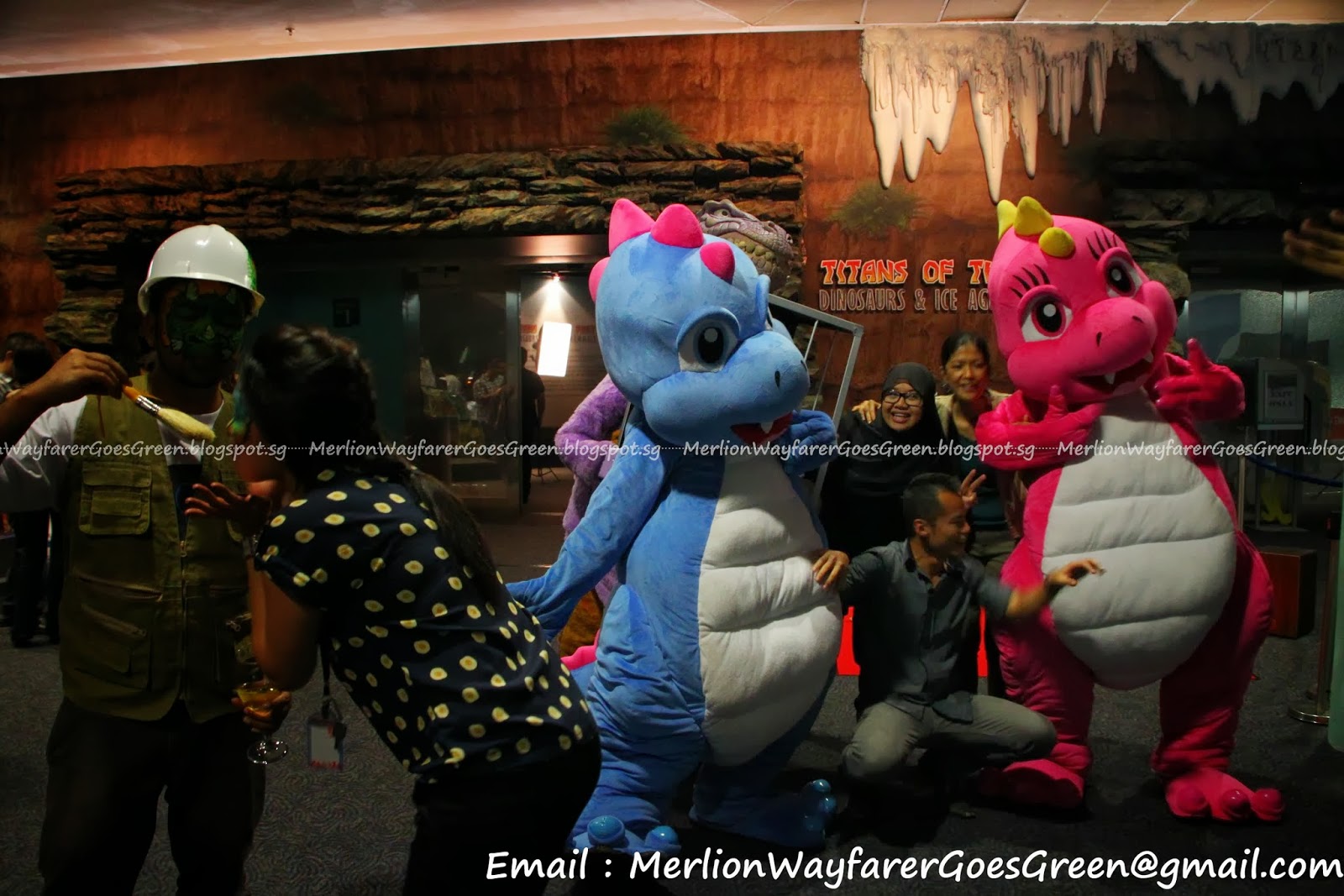
Last night, Merlion Wayfarer travelled back in time to the Cretaceous Period 65 million years ago...
 
Hail! A "dragon" from the past...

A herd of Triceratops - from Baby Tri all the way to Grandpa Tri...

Watch out! Don't breathe... Don't move at all!

More gigantic displays coming soon... Keep a look out!


There Is A Mountain In Front Of Me!

Singapore 
23 October 2013

Merlion Wayfarer's recent posting on mushrooms and flying saucers in the sky ("The Mushroom That Became A Flying Saucer At Sunset") created so much excitement among her friends that she decided to investigate the rare occurrence of these clouds...

Mushrooms & Flying Saucers

Lenticular clouds (Altocumulus lenticularis) are stationary lens-shaped clouds with a smooth layered appearance that form in the troposphere, normally in perpendicular alignment to the wind direction. Lenticular clouds can be separated into altocumulus standing lenticularis (ACSL), stratocumulus standing lenticular (SCSL), and cirrocumulus standing lenticular (CCSL). Due to their shape, they have been offered as an explanation for some Unidentified Flying Object (UFO) sightings.


Where stable moist air flows over a mountain or a range of mountains, a series of large-scale standing waves may form on the downwind side. If the temperature at the crest of the wave drops to the dew point, moisture in the air may condense to form lenticular clouds. As the moist air moves back down into the trough of the wave, the cloud may evaporate back into vapor. Under certain conditions, long strings of lenticular clouds can form near the crest of each successive wave, creating a formation known as a "wave cloud." The wave systems cause large vertical air movements and so enough water vapor may condense to produce precipitation. The clouds have been mistaken for UFOs (or "visual cover" for UFOs) because these clouds have a characteristic lens appearance and a smooth saucer-like shape.

Lenticularis often shows iridescence if it is near or in front of the sun. Bright colors (called irisation) are sometimes seen along the edge of lenticular clouds...


Lenticular clouds are usually spotted among mountain ranges...

(Source : Wikipedia)

There are some cases where these clouds have also been known to form where a mountain does not exist, but rather as the result of shear winds created by a front.

(Source : WordPress)

In this case, the front was created by a thick dense "mountain" of cumulus clouds amid a sky filled with higher-level alto and strato clouds...

The rare Flying Saucer in Singapore...


The Cloud Cap

Cap cloud or cloud cap is a stratiform, orographic cloud that hovers above or over an isolated mountain peak, formed by the cooling and condensation of moist air forced up and over the peak and lenticularly shaped by horizontal upper level winds. The cloud appears to remain essentially stationary.

The term is also occasionally used for Pileus (Latin for cap) cloud. Unlike the mountain cap cloud, the pileus is essentially an accessory cloud, that appears as a smooth cap, or hood above a cumulus or cumulonimbus cloud. The cap forms when a humid layer is lifted to its dew point above a rising thermal. This may later penetrate the pileus, which will eventually be absorbed into the main cloud body. Sometimes several layers of pileus form above one another.


The Shadow

A cloud shadow occurring at sunset is formed when light is cast from a low level cloud onto a higher level cloud. During a sunset, the sun's rays will sometimes be blocked by a cumulus cloud below the horizon. Like any shadow, a darkened area will form. These types of cloud shadows are especially dramatic and can appear as darkened rays of light, sometimes referred to as crepuscular rays, as they appear in the same direction as the setting sun.


More photos are available on Merlion Wayfarer Goes Green's Picasa at :
Natural Phenomena - Clouds


Sources